Talk to Mr. Saroj
- Home
- Destination
- Nepal Trekking
- Everest Region
- Everest View Trek
- Everest Base Camp Trek 14 Days
- Short Everest Base Camp Trek
- Luxury Everest Base Camp Trek
- Everest Base Camp Helicopter Trek – 12 Days
- Everest Base Camp and Gokyo Lakes Trek
- Everest Helicopter Tour in Nepal
- Gokyo Lakes Trek 12 Days
- Everest Three High Passes Trek
- Pikey Peak Trek – 10 Days
- Ama Dablam Base Camp trek – 9 Days
- Everest Region
- Annapurna Region
- Dhampus Sarangkot Trek
- Short Poon Hill Trek 3 Days
- Ghorepani Poon Hill Trek 4 Days
- Ghorepani Poon Hill Trek – 8 Days
- Mohare Danda Trek – 9 Days
- Annapurna Base Camp Heli Trek
- Short Annapurna Base Camp Trek- 6 Days
- Annapurna North Base Camp Trek– 9 Days
- Short Mardi Himal Trek
- Annapurna Base Camp Trek – 10 Days
- Mardi Himal Trek – 10 Days
- Annapurna Base Camp Trek Via poon Hill
- Ghorepani Poon Hill with Mardi Himal Trek
- Annapurna Base Camp and Mardi Himal Trek
- Short Annapurna Circuit Trek
- Annapurna Circuit Trek with Tilicho Lake
- Khopra Ridge Trek
- Kori Himal Trek -10 Days
- Nar Phu Valley Trek with Kang La and Thorong La Pass- 17 Days
- Ghorepani Poon Hill Yoga Trek
- Annapurna Base Camp Trek
- Mardi Himal Yoga Trek
- Annapurna Region
- Travel Info
- Company
- Contact
 Plan Your Trip
Bookings open for the 2026-2027 season! Start planning your dream journey.
Mardi Himal Yoga Trek

Mardi Himal Yoga Trek

Ghorepani yoga Trek

Price starts from
US$ 1200
For group of minimum 3 Pax
Group Discount Price
-
2 -
5 personUS$ 1200
-
6 -
10 personUS$ 1140
-
11 over
9999
US$ 1080
US$
Need Help?

Managing Director
Saroj (+977-9806627713)

Duration
10 Days

Trip Difficulty
Easy

Max Altitude
4,500m / 14,764ft

Activity
Sightseeing, Yoga, Meditation

Destination
Nepal

Group Size
2-20 People

Accommodation
Hotel, Teahouse

Meals
Breakfast, Lunch, and Dinner

Transportation
Tourist Bus, Private Vehicle
Highlights of Mardi Himal Yoga Trek
- A scenic tour of Kathmandu to Pokhara.
- Walking through the woods from Kande
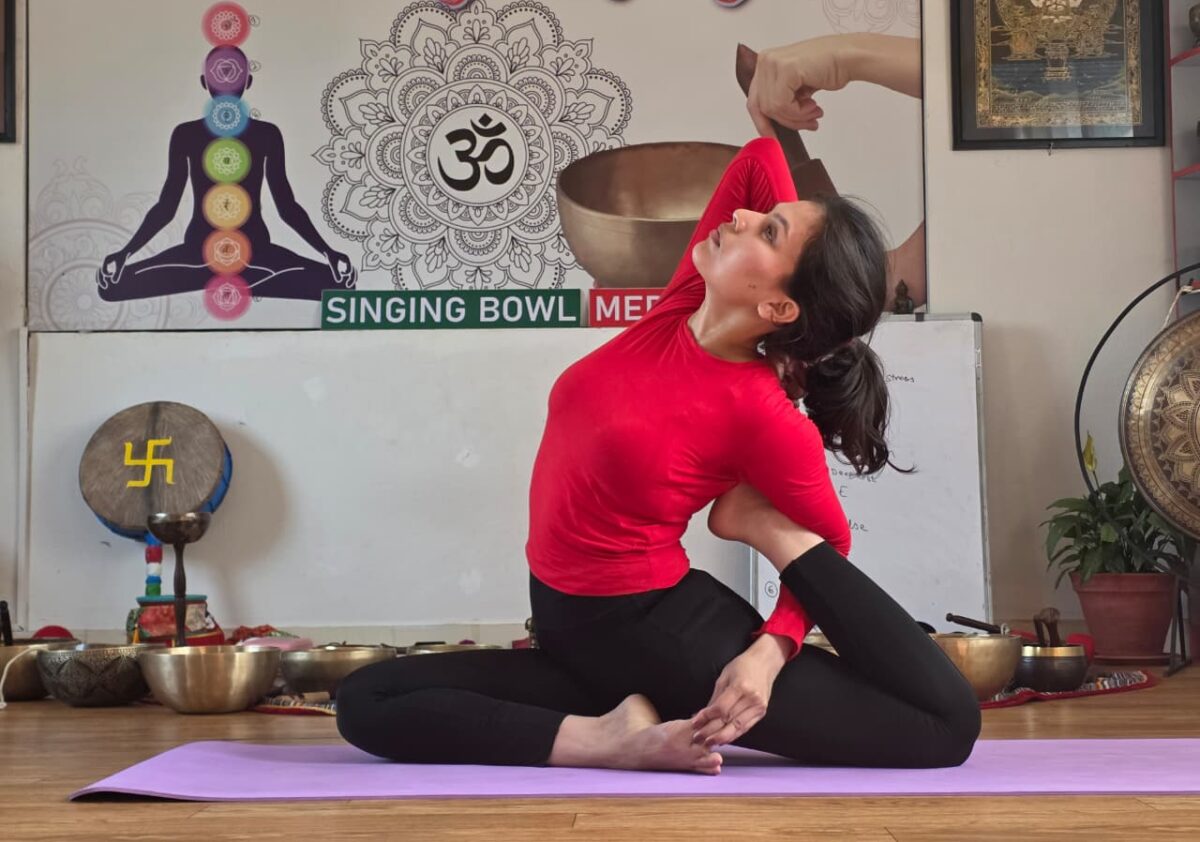
- Yoga, Pranayama and Meditation sessions
- Recovery yoga and stretching post-trek.
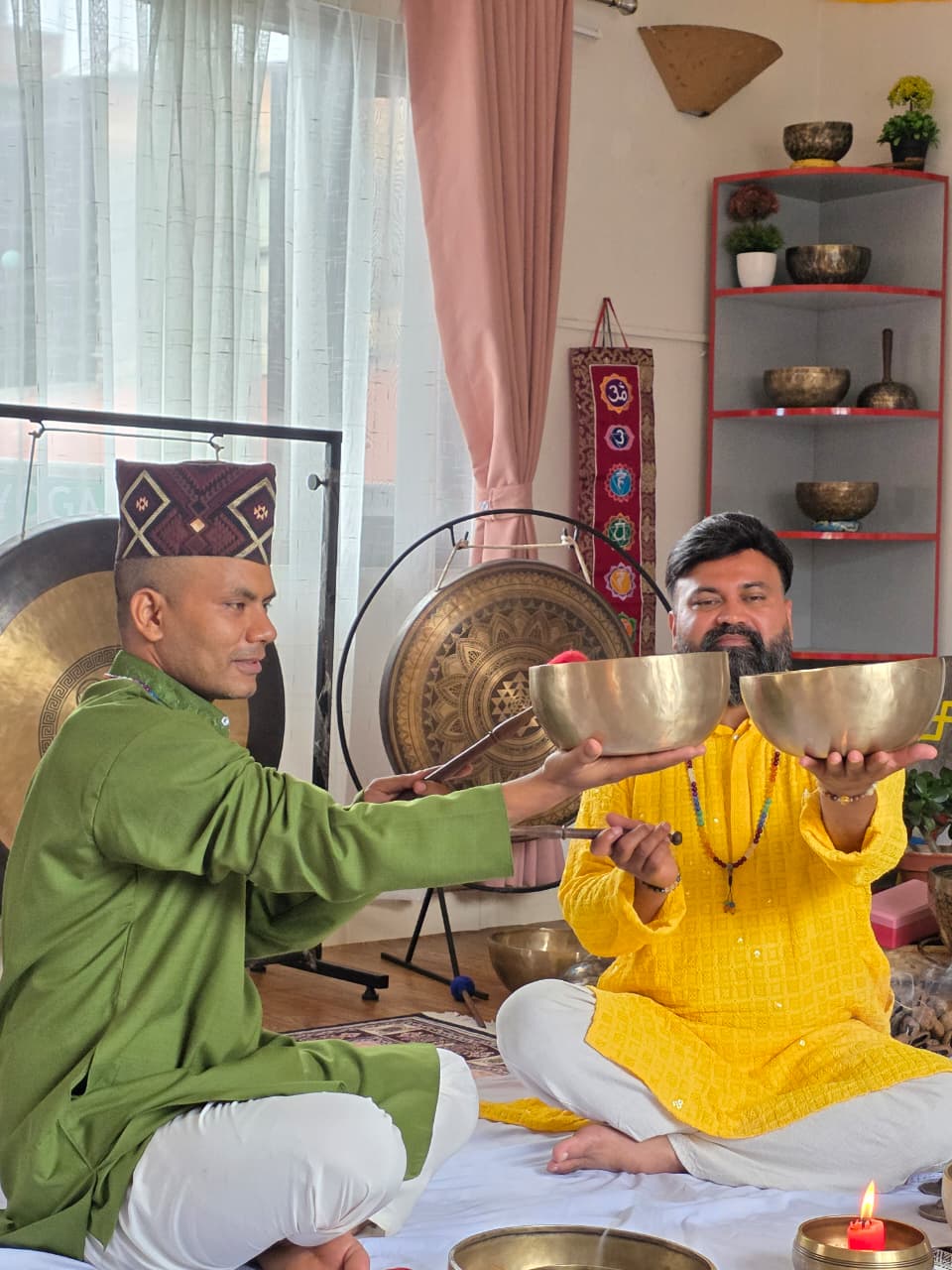
- Singing bowl Sound Healing Sessions
- Walking through rhododendrons and juniper trees
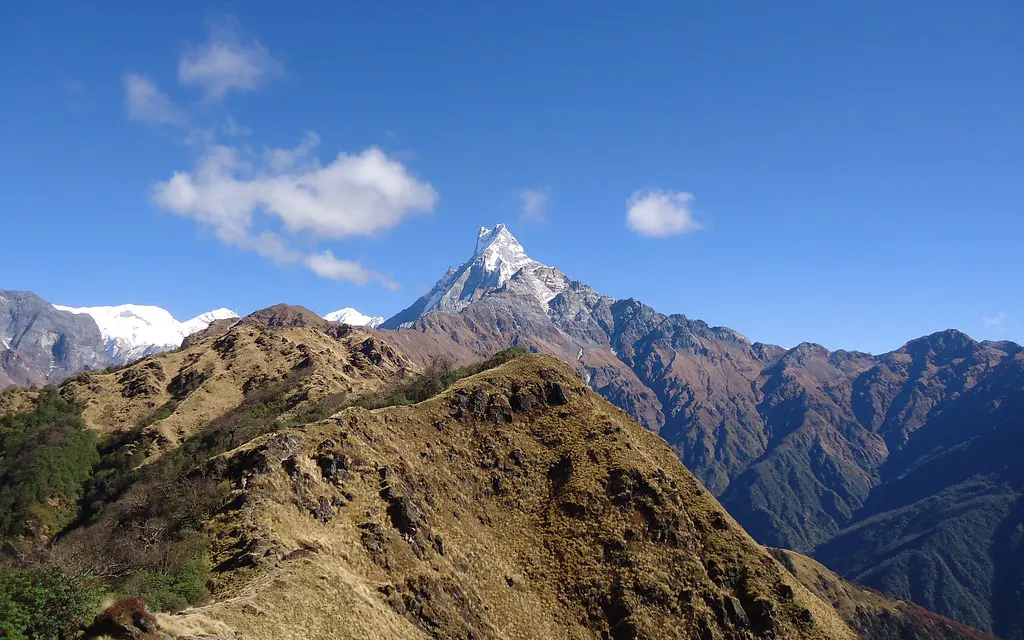
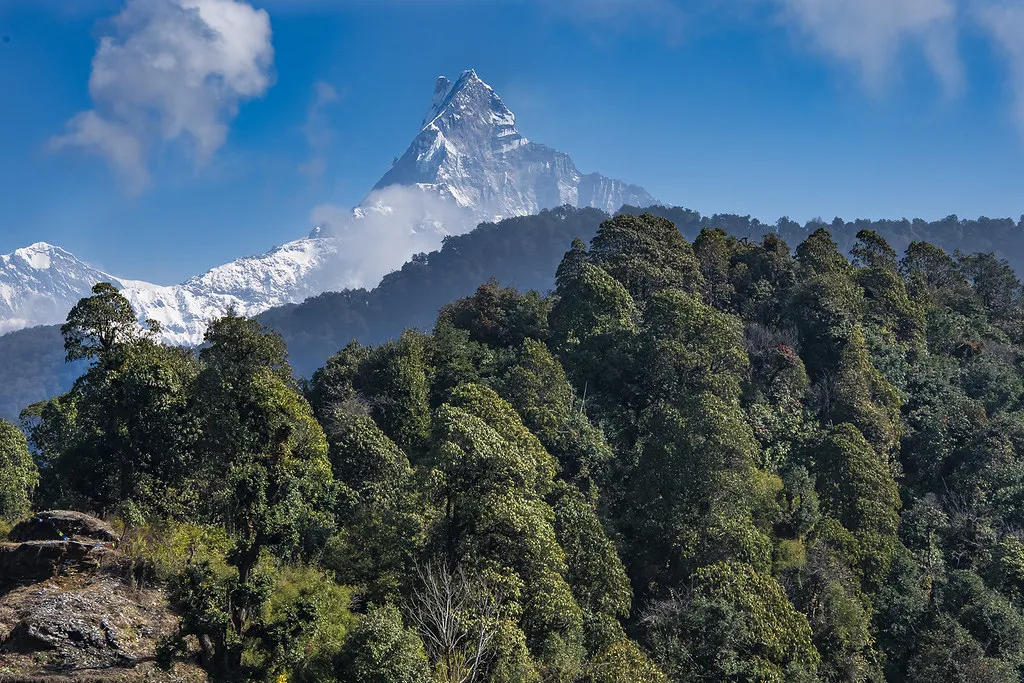
- Views of Machhapuchhre and Annapurna peaks from the mountain
- Overnight stay at High Camp (3,550 m /11,647 ft)
- Hike to Mardi Himal Base Camp (4,500 m /14,764 ft)
- Continue down to Siding Village and head back to Pokhara.
Trip Overview of Mardi Himal Yoga Trek
The Mardi Himal Yoga Trek combines a mountain trekking journey with daily yoga, breathing, meditation, stretching and sound healing sessions. It is intended for travelers who want to immerse themselves in the mountains while also fitting wellness activities into their tours.
The route starts in Kathmandu and then leads to Pokhara and the trek will begin from Kande. This walk then follows woods, small mountain villages and the higher Himalayan terrain. As you march through Pitam Deurali, Rest Camp and High Camp, the walk slowly climbs. The highest elevation in the provided Itinerary is Mardi Himal Base Camp (4,500 m /14,764 ft).
The Mardi Himal Yoga trek is a multi-day journey where each day offers the opportunity to walk and stay at the tea houses along the way, enjoying the landscape. The wellness program is structured on the trekking days from Day 3 to Day 7: 45 minutes of yoga, 15 minutes of Pranayama and 10 minutes of meditation each morning. The evening program consists of 30 minutes of recovery yoga/stretching and 45 minutes of singing bowl sound healing.
The hike also offers a variety of landscapes as you ascend from the bottom of the hills up to the top of the Mardi Himal region. For anyone who prefers a more well-rounded trek, instead of a trek full of walking, the Mardi Himal trek with Yoga is suitable.
Throughout the trip, Glory Adventure pvt.ltd Team arranges the main trekking service and transportation for the planned itinerary so you can concentrate on the trek, wellness sessions and time in the mountains.
Why Choose the Mardi Himal Yoga Trek?
Mardi Himal Yoga Trek is an excellent option for walkers who like to have regular time for yoga and other wellness exercises while walking in the mountains. The path leads down from the foothills to higher parts of the Mardi Himal region through forests, villages and views of the Himalayas.
One of the attractions of this trek is the incorporation of the yoga program. Each morning from Day 3 to Day 7, there is yoga, pranayama and meditation. There are evening sessions dedicated to recovery yoga, stretching and singing bowl sound healing, which provide extra time to unwind after walking.
The trek also has a progressive climb, making it easier to get used to the elevation changes. The summit of the programme is at about 4,500 m (14,764 ft).
The blend of trekking and relaxation, combined with the chance to practice yoga, makes the Mardi Himal Trek with Yoga an ideal choice for individuals who seek a blend of adventure, tranquility and mindful practice.
Mardi Himal Yoga Trek Route Overview
Mardi Himal Yoga Trek starts in Kathmandu and then continues with a beautiful drive to Pokhara. From Pokhara, you drive to Kande, the beginning of the trekking area. The trail slowly ascends through woodlands and the landscape of mountains to reach Pitam Deurali (2,100 m /6,890 ft).
The route then continues to Rest Camp (2,700 m /8,858 ft) before reaching High Camp (3,550 m /11,647 ft). An early morning walk from the High Camp to arrive at Mardi Himal Base Camp Trek (4500m /14764ft) and then descend to Badal Danda.
Then drive downhill to Siding Village, where you hire a private jeep back to Pokhara. A tourist bus returns to Kathmandu after spending a night in Pokhara. Yoga/wellness sessions are added to the trekking program on Days 3 to 7.
Itinerary of Mardi Himal Yoga Trek
Day 01: Arrival in Kathmandu and Transfer to Hotel
You will reach Tribhuvan International Airport in Kathmandu, where our representative will pick you up and drive you to your hotel. It takes only a short drive to reach Thamel and once there you can check in and have a rest after travelling.
If you’re feeling adventurous, you can walk around the surrounding streets of Thamel later in the day. One can go around the neighbourhood, get back to stocking up on trekking gear, or sample some local cuisine before heading back to the hotel.
The evening will be a time for relaxation and preparation for the journey that lies ahead. You will spend the night at a three-star hotel in Kathmandu. The provided itinerary includes Kathmandu at an elevation of 1,350 m (4,429 ft).

Activity & Duration
Airport pickup and private transfer to Thamel, Approximately 30 minutes drive
Highest Altitude
1350m / 4,429ft (Kathmandu)
Meals
-
Accommodation
Three star Hotel In kathmanduDay 02: Drive from Kathmandu to Pokhara by Tourist Bus
The tourist bus will depart Kathmandu after breakfast for Pokhara. This drive goes through the mid-hills of Nepal along the Prithvi Highway and will pass by rivers, villages, terraced agricultural fields and small towns.
It typically takes about 7-8 hours to drive this route, depending on the road and traffic. There will usually be opportunities for short stops during the journey for refreshments and meals.
After reaching Pokhara, you will check in at your three-star hotel and have time to rest. If you have any energy left in the evening, you can stroll around the Lakeside area to enjoy the views around Phewa Lake and have dinner at one of the local restaurants.
Overnight stay will be in a three-star hotel in Pokhara.
Activity & Duration
Tourist bus drive from Kathmandu to Pokhara, 7 to 8 hours driveHighest Altitude
820m / 2,690ft (Pokhara)Meals
BreakfastAccommodation
Three star Hotel In PokharaDay 03: Drive to Kande and Trek to Pitam Deurali
The morning will begin with breakfast in Pokhara and then you will travel by private car to Kande. The ride lasts for about 45 minutes and reaches the starting point of the Mardi Himal trek.
You will now enter dense forests and slowly ascend towards Pitam Deurali from Kande. This path alternates between green hills and rhododendron woodland and is a steady uphill path. Normally takes about 4-5 hrs to complete the trekking journey and is about 6 km.
On arriving at Pitam Deurali (2,100m/6,890ft), you will be accommodated in a tea house and rest.
You are starting your wellness program today. In the morning, you will get 45min of yoga, 15min of pranayama and 10min of meditation. Afternoon Yoga sessions will include 30 minutes of recovery yoga and stretching and 45 minutes of singing bowl sound healing in the evening. This will be followed by dinner and overnight rest.
Activity & Duration
Drive to Kande, trek to Pitam Deurali, yoga, pranayama, meditation, recovery yoga, stretching and singing bowl sound healing, 45 minutes drive + 4 to 5 hours trek + 2 hours 25 minutes wellness activitiesHighest Altitude
2100m / 6,890ft (Pitam Deurali)Meals
Breakfast, Lunch, DinnerAccommodation
Tea HouseDay 04: Trek from Pitam Deurali to Rest Camp
The morning will start with breakfast at Pitam Deurali, followed by a 45-minute yoga session, 15-minute pranayama and 10-minute meditation session. Following the morning well-being exercises, you will enjoy breakfast and get ready for the day’s journey to Rest Camp.
The trail gradually climbs through rhododendron and juniper forest. In the forest sections, where you will be walking through mainly quiet areas, you will then follow along the ridge with occasional views towards Machhapuchhre, where the vegetation starts to change with altitude.
The hike lasts about 5-6 hours and is about 9 km in distance. Once you arrive at Rest Camp (approximately 2700m/8858ft), you will stay in the tea house and enjoy lunch and/or refreshments, followed by a period of rest to prepare for the walk, or overnight, in the rest house.
A 30-minute yoga/recovery and stretching session will be offered in the evening, followed by 45 minutes of singing bowl sound healing. After dinner, you will go to bed.
Activity & Duration
Trek to Rest Camp, yoga, pranayama, meditation, recovery yoga, stretching and singing bowl sound healing, 5 to 6 hours trek + 2 hours 25 minutes wellness activitiesHighest Altitude
2700m / 8,858ft (Rest Camp)Meals
Breakfast, Lunch, DinnerAccommodation
Tea HouseDay 05: Trek from Rest Camp to High Camp
The day will start with breakfast in the Rest Camp, followed by a 45-minute yoga session, a 15-minute pranayama session and a 10-minute meditation session. After the session, you will get ready for the trip to High Camp for the day.
The path winds through the woods and finally opens up as you ascend. This walk will take you about 5-6 hours and 7 km. The high peaks begin to be seen as you ascend, such as the views of Machhapuchhre, Hiunchuli, Annapurna South and more.
You will arrive at High Camp (3550m /11647ft) and have lunch at this point before taking up residence in the tea house. Later afternoon can be spent enjoying the mountain environment, if the weather is favorable.
You will practice 30 minutes of recovery yoga/stretching in the evening followed by 45 minutes of singing bowl sound healing. Post-dinner, High Camp is where you will rest before an early morning start.
Activity & Duration
Trek to High Camp, yoga, pranayama, meditation, recovery yoga, stretching and singing bowl sound healing, 5 to 6 hours trek + 2 hours 25 minutes wellness activitiesHighest Altitude
3550m / 11,647ft (High Camp)Meals
Breakfast, Lunch, DinnerAccommodation
Tea HouseDay 06: Hike to Mardi Himal Base Camp and Trek Down to Badal Danda
Early morning will be your start time; this is the longest and highest day of the trek. You will take 45 minutes of yoga, 15 minutes of pranayama and 10 minutes of meditation in the morning wellness program before you set out.
From High Camp, you will start the heady ascent towards the Mardi Himal Base Camp area after breakfast. The trail is more open and challenging at higher elevations. The early start also provides you with a better opportunity to see clear mountain views before clouds start to set in later in the day.
It takes about 8 to 9 hours to cover the distance from Mardi Himal Base Camp to Badal Danda and the ride back to Mardi Himal Base Camp is around 12 km. The usual altitude for reaching Mardi Himal Base Camp (4,500 m /14,764 ft). You will later head down towards Badal Danda and end up at a tea house for dinner and a night’s stay.
This is a long day of trekking, so the recovery program can be kept light at night. After resting, there will be 30 mins of recovery yoga and stretching, then 45 mins of singing bowl sound healing.
Activity & Duration
Hike to Mardi Himal Base Camp, trek down to Badal Danda, yoga, pranayama, meditation, recovery yoga, stretching and singing bowl sound healing, 8 to 9 hours trek + 2 hours 25 minutes wellness activitiesHighest Altitude
4500m / 14,764ft (Badal Danda)Meals
Breakfast, Lunch, DinnerAccommodation
Tea HouseDay 07: Trek to Siding Village and Drive to Pokhara
The morning will begin with breakfast at Badal Danda and the last morning will feature a 45-minute yoga session, a 15-minute pranayama session and a 10-minute meditation session.
Following the wellness session and breakfast, you will head down to Siding Village. The path slowly descends into lower terrain and traverses some wooded areas and farmland. After driving through the sections close to Mardi Khola, you will arrive at Siding Village.
The descent to Siding is about 5 – 6 km long, taking about 3 – 4 hours. Once you have reached the village, you can take a rest and then enjoy lunch before proceeding to Pokhara by private jeep. This takes about 3 hours by car, depending on the road conditions.
Once in Pokhara, you will be accommodated in your hotel (three-star) and have time to relax. At the end of the night, you will enjoy 30 minutes of relaxation/yoga and stretching and 45 minutes of singing bowl sound healing. Dinner and overnight stay will then be at the hotel.
Activity & Duration
Trek to Siding Village, private jeep drive to Pokhara, yoga, pranayama, meditation, recovery yoga, stretching and singing bowl sound healing, 3 to 4 hours trek + approximately 3 hours drive + 2 hours 25 minutes wellness activitiesHighest Altitude
3210m / 10,531ft (pokhara)Meals
Breakfast, Lunch, DinnerAccommodation
Three star Hotel In PokharaDay 08: Drive from Pokhara to Kathmandu by Tourist Bus
In the morning, once breakfast is over, you will set off from Pokhara to return to Kathmandu on a tourist bus. The main road winds through the middle hills, passing through villages, farmland and hillside communities.
It will take approximately 7-8 hours to drive there depending on traffic and road conditions. There will be times during the trip for rest breaks with refreshments and meals as necessary.
Then you will arrive in Kathmandu, where you will check in to your 3-star hotel and be free for the remainder of the evening. If you like, you can unwind at the hotel or stroll around the area of Thamel.
This is your first full night in Kathmandu after the trek, which is a good opportunity to get a good night’s sleep, get your things in order and also to get ready for your sightseeing and shopping tomorrow. The package lists Kathmandu at 1,350 m (4,429 ft).
Activity & Duration
Tourist bus drive from Pokhara to Kathmandu, 7 to 8 hours driveHighest Altitude
1350m / 4,429ft (Kathmandu)Meals
BreakfastAccommodation
Three star Hotel in kathmanduDay 09: Kathmandu Sightseeing and Shopping
Breakfast at the hotel and a free day in Kathmandu. You may visit cultural and historical places of the Kathmandu Valley in the morning and rest after the hike; it depends on your interest.
Sightseeing places are Swayambhunath, Boudhanath, Pashupatinath, Kathmandu Durbar Square, Patan Durbar Square and Bhaktapur Durbar Square. These are available for you to select the places that suit your time and interests.
Once you have done sightseeing, you can have lunch and then have time to go shopping at Thamel or local markets like Asan. These are the places where you can get souvenirs and local products.
In the evening, you can come back to the hotel to rest or have a last night’s dinner in Kathmandu. This is a one-night stay at a three-star hotel.
Activity & Duration
Shoping dat at kathmandu valley and see the local placeHighest Altitude
1350m / 4,429ft (Kathmandu)Meals
BreakfastAccommodation
Three star Hotel in kathmanduDay 10: Departure from Kathmandu
The hotel where you stay will be the place to break your fast and prepare for your flight out of Nepal. This will vary depending upon your flight schedule and you will need to have your passport, travel documents and other necessities packed and ready to go for your departure from the hotel.
Our representative will pick you up from the hotel and drop you off at Tribhuvan International Airport by private car. The journey to the airport from Thamel is usually 20-30 minutes, but can be longer depending on traffic.
Once at the airport, you will complete your check-in and depart for another flight. This is the 10-day Mardi Himal Trekking & Wellness tour’s final day.
Activity & Duration
Drive to international airport back to homeHighest Altitude
1350m / 4,429ft (Home)Meals
BreakfastAccommodation
-Includes / Excludes of Mardi Himal Yoga Trek
What is included?
- All ground airport pick up and drop by private tranport.
- Two night’s twin basic 3-star hotel in Kathmandu with breakfast.
- Two night’s twin basic 3-star hotel in Pokhara with breakfast
- Kathmandu – Pokhara – Kathmandu both ways by tourist bus.
- Pokhara – khade and siding – pokhara by private Jeep
- During the treking tea house accommodaton .
- Meals ( Breakfast , Lunch and Dinner) Tea/ coffee during the Trek
- All trekking permits organised by Glory Adventure.
- Daily yoga classes from the 3rd to the 7th day.
- A yoga session on Pranayama and meditation from day 3 to day 7.
- Relaxation yoga and Day 3-7 stretching in the evenings
- Every day from Day 3 through Day 7, singing bowl sound healing sessions are held.
- Accompanying on the trek as per the itinerary
What is excluded?
- International flights to and from Nepal.
- Nepal tourist visa fee
- Emergency evacuation and travel insurance expenses
- The expenses and costs involved in the journey personal to each individual.
- Food and drinks of personal choice
- Laundry services at tea house and hot showers.
- WiFi / Internet fees (if applicable)
- The fee charged for use of a battery charger at a tea house.
- Individual trekking gear and clothes
- Individual medications and medical costs
- Advise guides, drivers and support staff of the following:
- Extra activities or travel not part of the tour program.
- Any service or expense not included under the items listed as part of the trip.
Route Map & Altitude Chart
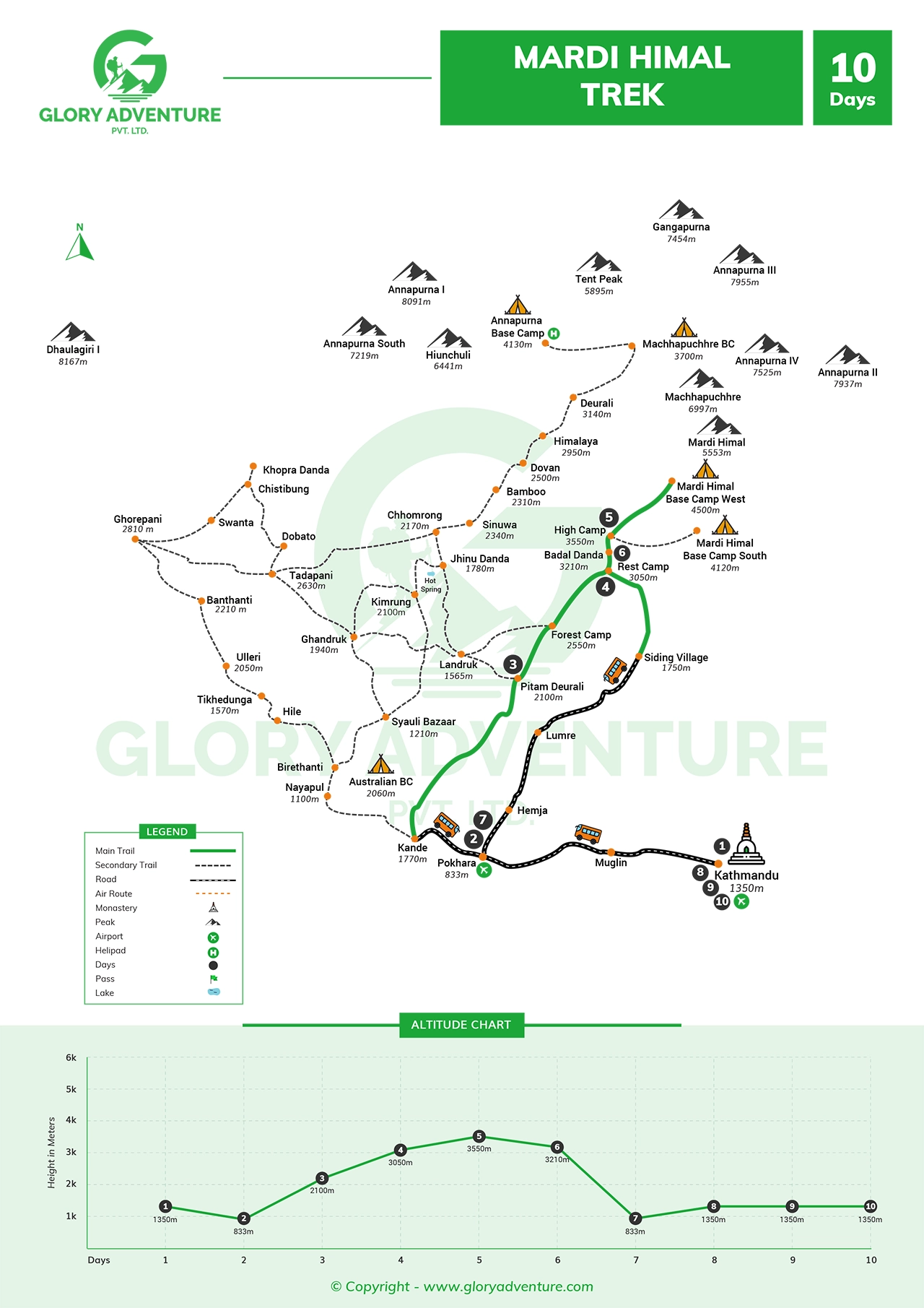
Essential Information of Mardi Himal Yoga Trek
Weather and the Best Season
Mardi Himal Yoga Trek can be performed during various seasons, but the best time for trekking is generally spring or autumn. The main trekking season is spring or autumn and October and November are ideal for mountain views.
| Season | Months | Weather and Trekking Conditions |
| Spring | March to May | Mild days, clear mornings, rhododendron flowers and comfortable trekking conditions |
| Summer/Monsoon | June to August | Rain, cloudy views, wet trails and possible leeches at lower elevations |
| Autumn | September to November | Clear skies, stable weather and good mountain visibility |
| Winter | December to February | Cold mornings and nights, possible snow at higher elevations, but generally clear days |
The upper regions can be much colder than Pokhara. The higher the altitude, the colder it gets, so warm clothing is essential even in spring and autumn.
Difficulty and Altitude Sickness
The Mardi Himal Yoga Trek is a moderate trek due to the presence of the high altitude, uneven trails and regular ups/downs of the trail. The peak of your trip is around 4500m (14764 ft), so altitude needs to be a big consideration.
Everyone can suffer from altitude sickness. Warning signs may include headache, dizziness, unusual fatigue, nausea and loss of appetite.
Important points:
- Walk at a slow pace and consistently.
- Drink water regularly.
- Stay away from alcohol at higher elevations.
- Take in adequate amounts of food when you are not hungry.
- If you are not feeling well, notify your guide as soon as possible.
- Do not continue climbing if symptoms are getting worse.
- If symptoms of severe altitude sickness appear, descend.
However, good pacing and gradual elevation gain will minimize the risk but not eliminate the risk of altitude sickness.
Insurance, Visa and Permits for the Trip
It is highly recommended to take travel insurance on the Mardi Himal Trek with Yoga, as the trek includes high altitude and trekking accidents or illness may require medical treatment or evacuation. Trekking activities, medical treatment and emergency rescue are recommended to be covered by insurance.
Most tourists will require a tourist visa from their home countries. Visas may be obtained at Tribhuvan Airport depending on the nationality of the travellers, or a visa application may be made in advance from a Nepali diplomatic mission abroad.
Glory Adventure will provide you with the trekking permits and documentation that are required for your trek. The necessary passport details and photographs should be given beforehand to facilitate the paperwork before the trek.
Training, Fitness Level & Mental Preparation
The Mardi Himal Yoga Trek route has a number of days of ascent and descent and some of the days are long trek days at high altitude. No prior experience of the mountains is required, but a fair degree of fitness will be appreciated.
Before the trek:
- Walk often for a few weeks before your departure.
- Add walking uphill or climbing stairs to your workout.
- Carry a light daypack regularly.
- Include basic leg and core strengthening activities.
- Practice regular breathing exercises.
- Take longer walks on weekends if possible.
It is important to be mentally ready as well. Long walking hours, weather, or altitude may cause some days to feel tiring. Do not rush; it’s better to be patient and walk at a comfortable speed.
The yoga, pranayama, meditation and evening recovery sessions on Days 3-7 can also help to bring relaxation and recovery to the journey.
Risk Factors on the Trek
The Mardi Himal Trek with Yoga is run in the mountain environment where the weather can change rapidly. Attributable risks can be avoided with careful preparation, good walking and advice from the trekking team.
Common risks include:
- Altitude sickness at higher elevations.
- Rats and mice on the ground in rainy/snowy conditions.
- Low temperatures experienced at higher camps.
- Dehydration and tiredness.
- Minor slips and falls on uneven trails.
- Aches and pains following extended walking hours.
- Changing mountain weather.
- Poor access to health care services in remote areas.
- Clouds and rain that make it hard to see.
The area heading towards the Mardi Himal Base Camp is steep and high, so it is a difficult section. If you take a walk at a controlled pace and follow your guide’s instructions, you can minimize all unnecessary risks.
Health & Safety
It’s crucial to prepare for the Mardi Himal yoga trek in good health. It is recommended that physical preparation for high-altitude trekking be done and travellers take insurance for trekking and medical treatment.
For a safer trek:
- Have an adequate amount of water all day.
- Eat regular meals.
- Keep your hands and personal items clean.
- Keep out of strong sunlight.
- Take simple personal prescription medicines.
- Let the guide know of any medical issues.
- Take breaks as needed.
- Report the symptoms of altitude changes as soon as they occur.
- Follow the guide’s instructions on difficult sections.
- Have emergency contact numbers readily at hand.
If you have any medical condition or if you are not sure about the capability of high-altitude trekking, you should also consult with your doctor before the trek.
Transportation
Transportation is made easier from the start of the Mardi Himal Yoga Trek. This tour consists of Airport transfers from Kathmandu, a tourist bus ride from Kathmandu to Pokhara, a private jeep ride from Siding back to Pokhara and a drive from Pokhara to Kande.
Glory Adventure will make necessary arrangements for transportation on the trip as per the itinerary. This means that the main road transfers are not arranged separately.
A tourist bus takes you from Pokhara to Kathmandu as well. On your return day, the following service is planned, including airport transfer.
Traffic, road conditions, weather, or construction may impact Nepal’s road travel. Therefore, the driving times mentioned should not be considered as definitive.
Your Extra Expenses
Mardi Himal Yoga Trek package covers the services mentioned in your trip inclusions; however, you may have some additional expenses on your own during the trek.
Some additional expenses may be:
- The cost of a tourist visa for Nepal.
- Individual food and beverages.
- If not included, bottled or filtered drinking water.
- Hot showers at tea houses.
- Mobile data and Wi Fi charges.
- Battery charging fees.
- Personal shopping, souvenirs.
- Advice on guiding and support.
- Personal medicines, personal toiletries.
- Additional accommodation or transport due to personal changes.
- Cost of an evacuation or medical costs not covered by insurance.
Having some Nepalese rupees will be helpful as there are few villages in the mountains where card payment can be made. Having a small sum of cash on hand also helps to cover smaller personal expenses.
Language & Communication
Nepali is the primary tongue in Nepal and English is widely used in the tourist areas. The trip to Mardi Himal is with Yoga – most of the time, your guide and trekking staff will be speaking English or another mutually agreed language with you.
Local and Nepali languages can be heard in some of the villages along the trail. There are a few basic Nepali words that can ease the way into everyday communication and are friendly to residents.
Useful words are Namaste (hello), Dhanyabad (thank you) and Pani (water).
Your guide can assist you with your food orders, in speaking with the people at the tea house and in communicating with the local services. It’s easier to keep essential information written down or saved on your mobile phone in remote areas, where communication is limited.
Mobile Network, Internet & Charging Facilities
There is mobile coverage in many parts of the Mardi Himal Yoga Trek, but it is not the same for the whole trek. The coverage may be limited or non-existent in forested and remote mountain areas.
Tea houses can offer Wi Fi, but it can be slow when many people are connected. Internet access should thus be considered a convenience and not a certain service that is expected to be available while traveling.
Most of the tea houses have electric power, but you might find there’s a fee for charging. Some charging facilities may be shared during busy times.
When power is available, it is advisable to have a power bank to keep your phone, camera and other important devices charged. It’s helpful to download maps, important documents and entertainment before leaving Kathmandu.
Don’ts on This Trip
On the Mardi Himal Trek with Yoga, you travel through local villages, woods and mountain regions where the environment is particularly well protected. This is good for the character of the trail and better for other walkers and local communities.
Please avoid:
- Please do not litter on the trail.
- Avoid littering plastic bottles and wrappers in forests and rivers.
- Do not disturb wildlife.
- Avoid harming vegetation and trees.
- No trespassing.
- Please do not take pictures of people without their consent where appropriate.
- Please do not disregard your guide’s safety advice.
- Avoid running on steep or slippery trails.
- If severe altitude symptoms occur, stop walking.
- Do not use too much water or electricity in tea houses.
- Avoid excessive noise in villages or in religious premises.
Not only is it important to respect local people and the natural environment while trekking in Nepal, but it is also a considerable part of responsible trekking in Nepal.
Cultural Festivals on the Trail
The Mardi Himal Yoga Trek goes through villages of people who live in accordance with their traditional ways. Villages can get busier during festivals and it is possible to observe local traditions and customs, music, food and religion.
Many festivals in Nepal are lunar, so their timing may vary from year to year. Major festivals are Dashain and Tihar and local communities can also hold their own festivals.
Spring is an interesting time as rhododendron forests begin to bloom and autumn is normally a trekking season with stable weather. Rhododendrons flower in the springtime and autumn is a time of clearer skies following the monsoon.
Your guide will be able to help you understand the customs and will be able to explain how to take part appropriately if your travels fall on a local festival day. Obey local regulations at temples, shrines, homes, or ceremonial sites.
Tips for First-Time Nepal Visitors
Mardi Himal Yoga Trek is a first-time trek in Nepal, which is easier to do if a person is prepared for the trek and everyday life in Nepal.
Useful tips include:
- Do not leave your travel documents and passport unattended.
- Take some Nepalese currency for personal expenses.
- Drink plenty of water while trekking.
- Layer up – high altitudes means change of temperatures.
- Carry a power bank for remote areas.
- Do not exceed the agreed weight of the luggage.
- Know some basic Nepali vocabulary.
- Sensitively treat local culture and places of worship sensitively.
- Don’t race the others; go at your own pace.
- Be flexible – roads and weather can change.
- Take your guide’s instructions wherever you go, especially as you ascend higher.
- Get travel insurance that includes trekking and emergency evacuation.
Visitors to Nepal are generally welcome, but travel precautions are required. No trekking is recommended to be done alone and it is recommended that trekkers be accompanied by a guide from a registered trekking agency.
What Makes This Trek Different from a Regular Mardi Himal Trek
The normal Mardi Himal trek is primarily a trek on the trails of the mountain and reaching the viewpoints which are situated higher. The Mardi Himal Yoga Trek also provides a well-planned wellness programme which allows you to take time for physical activity and relaxation.
| Regular Mardi Himal Trek | Mardi Himal Yoga Trek |
| Focuses mainly on trekking | Combines trekking with wellness activities |
| Standard morning routine | Morning yoga, pranayama and meditation |
| Rest after the day’s trek. | Recovery yoga and stretching in the evening |
| Free evening time | Singing bowl sound healing |
| Mainly focused on the mountain route. | Balances walking, relaxation and mindfulness |
The extra program from Day 3 to Day 7 consists of 45 minutes of yoga, 15 minutes of pranayama and 10 minutes of meditation in the morning. There are 30 minutes of recovery yoga and stretching followed by 45 minutes of singing bowl sound healing in the evening.
This differentiates the Mardi Himal Yoga Trek experience from people who wish to get wellness activities in their mountain tour.
A Typical Wellness Day on the Trail
The morning wellness session is followed by the day’s trekking, which starts at a typical time. Starting from Day 3 and up to Day 7, 45 minutes of yoga will be followed by 15 minutes of pranayama and 10 minutes of meditation.
Breakfast will be served at the end of the session and preparations will be made for the walk of the day. The trekking is the primary activity during the day. Depending on the walk, you might walk through the forest, mountain trails and higher portions of the walk before arriving at the next tea house.
As soon as you arrive at your accommodation, you will be able to rest, refresh and enjoy a delicious dinner. Afterwards, the wellness program proceeds with 30 minutes of relaxation yoga and stretching.
There are 45 minutes of singing bowl sound healing at the end of the day. Then dinner, rest and get ready for the next day’s hike. This is a simple practice that helps to balance the Mardi Himal wellness trek.
Yoga at High Altitude: What to Expect
Yoga is offered as a relaxing exercise instead of a rigorous one. The body requires time for acclimatisation as the Mardi Himal Yoga Trek goes to higher elevations; therefore, the sessions should be taken at a comfortable pace.
The morning class consists of 45 minutes of yoga, 15 minutes of pranayama and 10 minutes of meditation. At this elevation, it is recommended that the student follow the instruction of the instructor and not exceed their comfort level.
The peak of your trip is about 4,500 m (14,764 ft). Simple physical activity can become harder than it is at lower altitudes.
Let your guide and your wellness instructor know if you have a headache, dizziness, nausea, unusual tiredness, or other symptoms of altitude sickness. Safe acclimatization should always be the priority, not completing every exercise.
What to Expect from Singing Bowl Sound Healing
Day 3-7 Evening Wellness includes singing bowl sound healing. This session is approximately 45 minutes in length and is conducted at the end of the day’s trek and recovery stretching session.
The activity is based on singing bowls and the sound and vibrations they create during a guided relaxation. It will be used to give the dog a quiet time after walking and can be a basic method to calm the dog down before eating and before going to bed.
In the session, you will have the opportunity to:
- A quiet and peaceful setting
- Relaxation, using the sounds of the singing bowl.
- Comfortable sitting/resting time
- Slowly changing from walking to sleeping at the end of the day.
- A session that is about 45 minutes in length.
This activity is included in the Mardi Himal Yoga Trek experience, which has a distinct evening schedule from a normal trekking package, consisting of recovery yoga, stretching, etc. There is no need to have any prior experience in singing bowls or meditation.
Who Is This Trek Best Suited For?
The Mardi Himal Yoga Trek is an ideal experience for those who wish to enjoy the mountains while also engaging in typical wellness pursuits. There is no requirement to be an experienced yoga practitioner to join the program, as it is part of the daily program.
It can be appropriate for those who like to walk but need some time for stretching, breathing exercises, meditation and relaxation. It could also be good for travelers who want more of a balanced daily schedule as opposed to resting all of their free time after the trip.
Reasonable fitness is also a must since there is some uphill and downhill walking and a high elevation. The trekking reaches are of varying length – Day 6 is the longest and highest on the itinerary.
The Mardi Himal wellness trek is thus an ideal choice for those seeking a blend of trekking, indulgence, scenic mountains and organized relaxation.
Frequently Asked Question (FAQ’s)
No, it’s not necessary to have done yoga before. The wellness sessions can be modified and are appropriate for beginners.
The wellness activities scheduled in Days 3-7 are roughly 2 hours and 25 minutes a day.
It’s okay to rest rather than take part in a session if you feel tired, uncomfortable, or if altitude affects you.
In the trekking area, accommodation is made available in the tea house and in Kathmandu and Pokhara in 3-star hotels.
Yes, during the trekking days breakfast is included, but this could be altered depending on time-out requirements.
Yes, there may be more days available depending on availability, transportation, accommodations, etc. and your travel itinerary.
The schedule will be reassessed by your trekking party and changes will be made when weather and/or trail conditions pose safety issues.
Generally speaking, tea houses offer vegetarian options, allowing you to find meals that suit your dietary needs.
There is normally no need to bring additional luggage with you if you are staying in Pokhara or Kathmandu during the peak days and nights of peak season and only what is required for the mountain experience.
The wellness program is included in this trip itinerary, but it can be discussed with the trekking team based on each person’s condition.
Trip Reviews on Mardi Himal Yoga Trek

Price starts from
US$ 1200
For group of minimum 3 Pax
US$
Need Help?
Managing Director
Saroj (+977-9806627713)
Related Trips


Saroj Sunar
Travel Consultant
Looking for a Private Trip?
Say Hello to Your Travel Consultant
Planning your next getaway? Our travel specialists are ready to design a fully customized package tailored to your interests. If you need help or have any questions, feel free to connect with us—we’re here to guide you from start to finish.
Price starts
US$ 1200
✖
Free Trip Planner
Talk to
Mr. Saroj Sunar