Talk to Mr. Saroj
- Home
- Destination
- Nepal Trekking
- Everest Region
- Everest View Trek
- Everest Base Camp Trek 14 Days
- Short Everest Base Camp Trek
- Luxury Everest Base Camp Trek
- Everest Base Camp Helicopter Trek – 12 Days
- Everest Base Camp and Gokyo Lakes Trek
- Everest Helicopter Tour in Nepal
- Gokyo Lakes Trek 12 Days
- Everest Three High Passes Trek
- Pikey Peak Trek – 10 Days
- Ama Dablam Base Camp trek – 9 Days
- Everest Region
- Annapurna Region
- Dhampus Sarangkot Trek
- Short Poon Hill Trek 3 Days
- Ghorepani Poon Hill Trek 4 Days
- Ghorepani Poon Hill Trek – 8 Days
- Mohare Danda Trek – 9 Days
- Annapurna Base Camp Heli Trek
- Short Annapurna Base Camp Trek- 6 Days
- Annapurna North Base Camp Trek– 9 Days
- Short Mardi Himal Trek
- Annapurna Base Camp Trek – 10 Days
- Mardi Himal Trek – 10 Days
- Annapurna Base Camp Trek Via poon Hill
- Ghorepani Poon Hill with Mardi Himal Trek
- Annapurna Base Camp and Mardi Himal Trek
- Short Annapurna Circuit Trek
- Annapurna Circuit Trek with Tilicho Lake
- Khopra Ridge Trek
- Kori Himal Trek -10 Days
- Nar Phu Valley Trek with Kang La and Thorong La Pass- 17 Days
- Ghorepani Poon Hill Yoga Trek
- Annapurna Base Camp Trek
- Mardi Himal Yoga Trek
- Annapurna Region
- Travel Info
- Company
- Contact
 Plan Your Trip
Bookings open for the 2026-2027 season! Start planning your dream journey.
Manaslu Annapurna Circuit Trek

Price starts from
US$ 1425
For group of minimum 3 Pax
Group Discount Price
-
1 personUS$ 1500
-
2 -
5 personUS$ 1425
-
6 -
10 personUS$ 1350
-
11 -
15 personUS$ 1275
-
16 over
9999
US$ 1200
US$ 1500
Need Help?

Managing Director
Saroj (+977-9806627713)

Duration
23 Days

Trip Difficulty
Difficult

Max Altitude
5,461m / 17,917ft

Activity
Trekking, Sightseeing

Destination
Nepal

Group Size
2 to 25 People

Accommodation
Hotel, Teahouse

Meals
Breakfast, Lunch, Dinner

Transportation
Tourist Bus, Car
Highlights of Manaslu Annapurna Circuit Trek
- Two great trekking areas of the Himalayas in one trip of 23 days.
- Trek through the remote Budhi Gandaki Valley and traditional mountain villages
- Visit Samagaon and Samdo to immerse yourself in Tibetan Buddhist culture
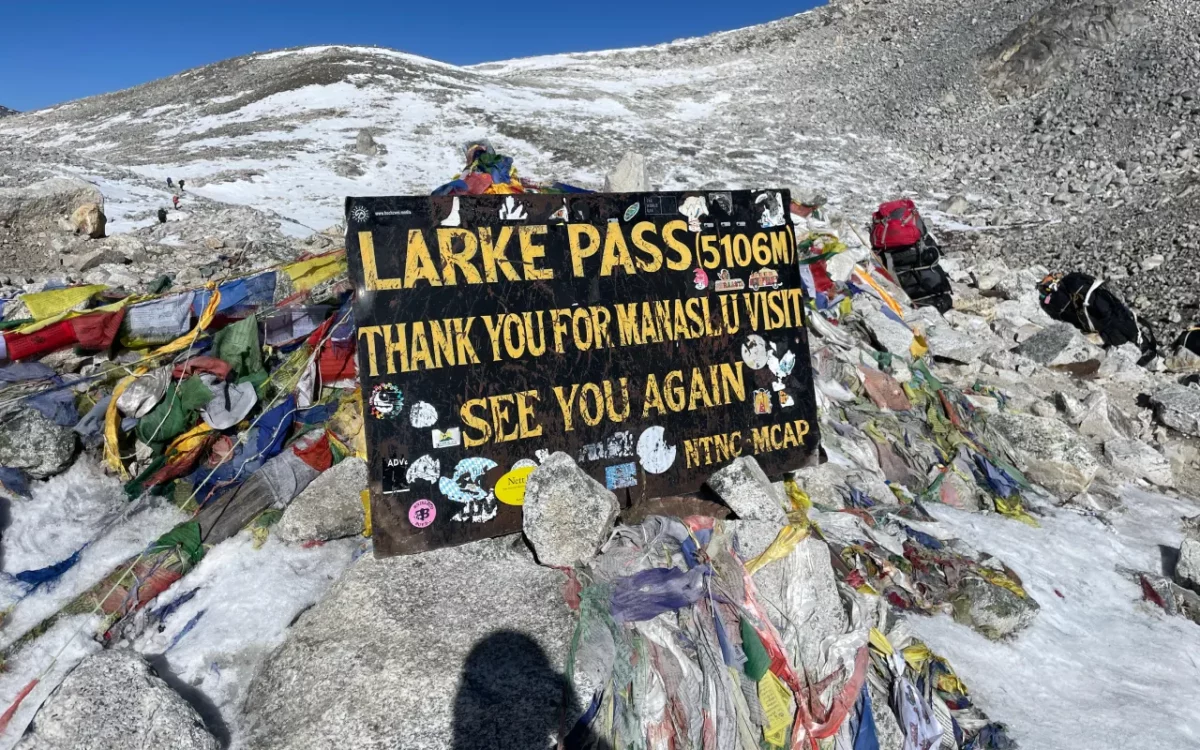
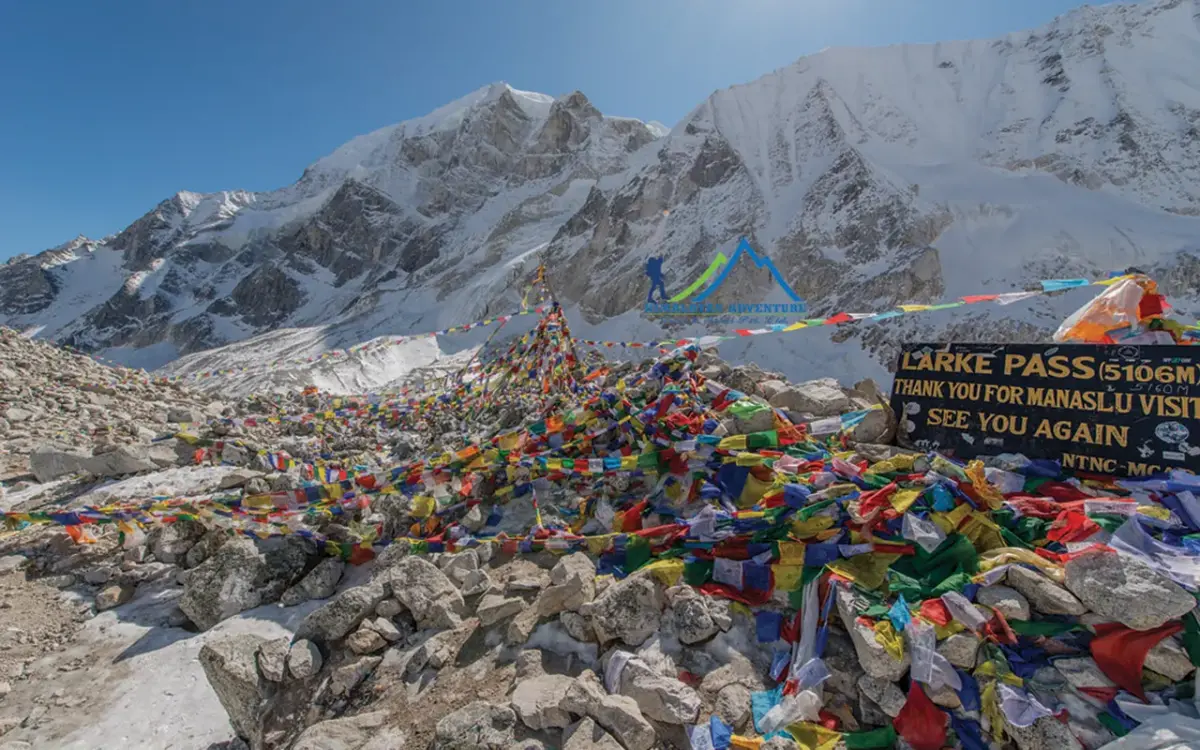
- Cross Larkya La Pass at about 5,106 m / 16,752 ft)
- Stroll through the changing terrain from Manaslu towards the Annapurna region
- Take a day to acclimatize in Manang before moving to the higher areas
- Cross Thorong La Pass at about (5,416 m / 17,769 ft)
- Cross Thorong La and visit the important pilgrimage site of Muktinath.
- Pass through the dry land of Kali Gandaki Valley to Jomsom.
- Fly to Pokhara from Jomsom and then back to Kathmandu, following beautiful scenery.
Trip Overview of Manaslu Annapurna Circuit Trek
The Manaslu Annapurna Circuit Trek is a 23-day journey that connects two major trekking regions of Nepal. The course starts in the lower Budhi Gandaki Valley and then gradually ascends towards the high mountains of Manaslu. As you cross through Larkya La Pass, the path heads through the Annapurna region to Thorong La Pass and down to Muktinath and Jomsom.
The trail begins with a road trip from Kathmandu to the walking portion, Machha Khola. The path passes through forests, through traditional villages, across suspension bridges and through small mountain valleys along the Budhi Gandaki River. The view goes from green hills to alpine landscape as the elevation rises. You can experience Tibetan traditions and local life in villages like Namrung, Lho, Samagaon and Samdo.
The highest point in the Manaslu Circuit Trek is Larkya La Pass (5,106 m / 16,752 ft). This crossing is an early start, challenging walk and preparation for cold/camp conditions is required. Crossing the pass, the trail heads towards Bimthang and Dharapani, where it slowly merges into the Annapurna area.
The second part of the trip is along the Marsyangdi Valley to Chame, Pisang and Manang. As the path rises, the landscape keeps shifting, offering glimpses of arid mountain terrain, pine forests and the surrounding peaks, along with a taste of traditional mountain architecture. It’s helpful to spend one day acclimating in the town of Manang to prepare for the higher levels that are to come.
Another significant challenge of the Annapurna Circuit Trek is Thorong La Pass. The highest point of the entire journey is at approximately 5,416 m / 17,769 ft. The path then descends from the pass towards Muktinath and then passes through the arid terrain of the Kali Gandaki Valley to Jomsom.
The journey ends with a flight from Jomsom to Pokhara and a drive back to Kathmandu. Throughout the journey, trekkers encounter various landscapes, communities, climate and cultural traditions in a single journey. There are also a few rest and acclimatization days included in the itinerary to help cope with the long journey.
The trekking arrangements, permits, transportation, accommodation, guides and other support are included in the package and provided by Glory Adventure. This walk is a more practical option to explore the Manaslu mountain region along with the Annapurna mountain region in a long trek if you are prepared and walk comfortably even at a moderate speed.
Why Manaslu Annapurna Circuit Trek?
The Manaslu Annapurna Circuit Trek is recommended for trekkers who want to enjoy two significant regions of the Himalayas in one trek. The path involves distant villages in the mountains, river valleys, forests, high alpine terrain and traditional settlements.
Manaslu Circuit Trek passes through Budhi Gandaki Valley and through Larkya La Pass (approx 5106 m / 16752 ft). There are Tibetan-influenced villages and quieter areas to see before visiting the Annapurna region.
The next big pass crossing on the Annapurna Circuit Trek is Thorong La (5,416 m / 17,769 ft). The trail then drops and passes towards Muktinath and Jomsom, where the land becomes more arid and more affected by Mustang.
The trek is ideal for those who want a longer adventure in the Himalayas, exploring diverse landscapes, cultures and high-elevation trekking.
Route Overview
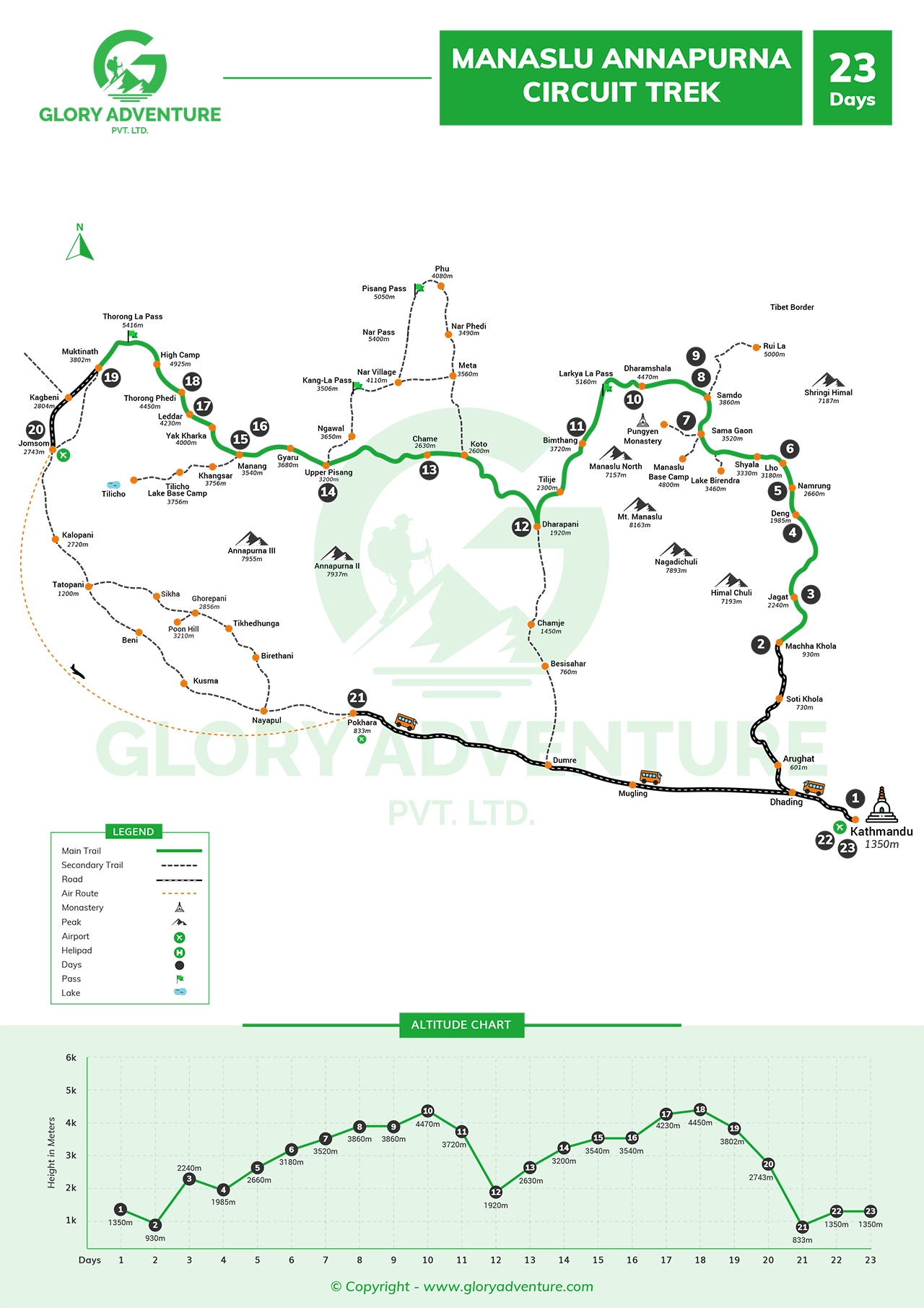
The Manaslu Annapurna Circuit Trek starts from Kathmandu to Machha Khola for the trek. The route passes through the Budhi Gandaki Valley in the city of Jagat, Deng, Namrung, Lho, Samagaon and Samdo and finally reaches Dharamshala.
From Dharamshala, the trek goes across Larkya La Pass (5106 m / 16752 ft) and descends to Bimthang and Dharapani. The Manaslu Circuit Trek track then heads into the Annapurna region.
The trail passes through Chame, Upper Pisang, Manang and then to Thorung Phedi. The section of the Annapurna Circuit trek has its highest point at Thorong La Pass (5,416 m / 17,769 ft) and then descends to Muktinath.
Travel then to Jomsom, then to Pokhara by plane and then to Kathmandu by car again.
Itinerary of Manaslu Annapurna Circuit Trek
Day 01: Arrival in Kathmandu (1,400 m / 4,593 ft)
You’re in Kathmandu, the beginning of your trek up the Manaslu and Annapurna. Once you arrive at Tribhuvan International Airport, you will be met by the team and a private car will be provided to take you to the hotel. From the airport to the hotel is typically a brief trip (depending on the traffic).
After you have checked in, you can relax following your international trip or take some time to meander around the area if you have time. A great chance to meet your guide and get ready for the trek.
Our crew will ensure the proper preparations are made before the trip the following morning.

Activity & Duration
30 minutes to 1 hour
Highest Altitude
1400m / 4,593ft (Kathmandu)
Meals
None
Accommodation
HotelDay 02: Drive from Kathmandu to Machha Khola (890 m / 2,920 ft)
It starts with a long drive from Kathmandu towards Machha Khola. We shall proceed on the road towards Arughat and then by shared jeep to the starting point of the trek, Machha Khola. The trail goes through river valleys, hills, terraced farmland and rural villages.
This is a long ride, depending on the conditions on the road, especially after Arughat. The entire ride will usually take about 8-9 hours, depending on traffic and road conditions.
On arrival in Machha Khola, you will stay in a teahouse and take a rest. The walking part of the Manaslu Circuit starts the next morning.
Activity & Duration
8 to 9 hours DriveHighest Altitude
1400m / 4,593ft (Machha Khola )Meals
Breakfast, Lunch and DinnerAccommodation
TeahouseDay 03: Trek from Machha Khola to Jagat (1,340 m / 4,396 ft)
We leave Machha Khola at breakfast time and walk in the Budhi Gandaki Valley. The path winds through the river in places and climbs up suspension bridges and then through small villages.
There are a few easy ups and downs, some rocks and a few uneven surfaces on the route. The track remains more mountainous and the surrounding villages smaller as it goes on.
After some 6-7 hours of walking, the place of Jagat is reached. This is an integral part of the Manaslu Trail, which is a definite transition as one enters the Manaslu restricted area.
Activity & Duration
6 to 7 hoursHighest Altitude
1340m / 4,396ft (Jagat )Meals
Breakfast, Lunch and DinnerAccommodation
TeahouseDay 04: Trek from Jagat to Deng (1,860 m / 6,102 ft)
The trail today continues further down the Budhi Gandaki Valley. We head out of Jagat and then stroll through forests and cultivated fields along the river, upstream. This path features steps and suspension bridges as well as rough mountain hiking.
The plants and environment around the area change as the elevation rises. There are several small villages along the way where you can stop and experience some local life.
Walking to Deng will take about 6-7 hours. When we reach the valley, it is running down and the mountains are nearer. Overnight stay in the local teahouse; prepping for the higher portions that follow.
Activity & Duration
6 to 7 hours TrekHighest Altitude
1860m / 6,102ft (Deng)Meals
Breakfast, Lunch and DinnerAccommodation
TeahouseDay 05: Trek from Deng to Namrung (2,630 m / 8,628 ft)
A walk from Deng to Namrung will lead us deeper into the upper Budhi Gandaki Valley. Following breakfast, we cross the river and head through the wooded areas, steadily rising.
This hike goes through a number of small communities and is a combination of forest trails, stone trails and open mountain. The surrounding peaks start to appear as we near Namrung and the terrain starts to be more of a high-mountain terrain.
This walk requires about 6-7 hours. Namrung is a larger settlement where we can rest after a day of climbing and prepare for the next part of our journey towards Lho, with teahouses available here.
Activity & Duration
6 to 7 hours TrekHighest Altitude
2630m / 8,629ft (Namrung)Meals
Breakfast, Lunch and DinnerAccommodation
TeahouseDay 06: Trek from Namrung to Lho (3,180 m / 10,433 ft)
After breakfast, we leave Namrung and head towards Lho. The trail winds through the woods and open spaces and by the end of the day, you’ll have reached the village of Sho, where you can find lodging for the night. This path leads through villages, including Lihi and Sho and eventually into the village at the end of the day where you can stay for the night. The stone houses, mani walls and prayer stones become more prevalent as the tour moves into a more Tibetan Buddhist-influenced area.
It will be a bit shorter a distance on some of the previous days, but it takes a steady pace to get to the top. The surrounding mountain scenery also starts to become more noticeable as we approach Lho.
We arrive at Lho after going on a walk for approximately 4 to 5 hours and take in a tea house. The village offers a view towards the peaks of the Manaslu range in clear weather.
Activity & Duration
4 to 5 hours TrekHighest Altitude
3180m / 10,433ft (Lho )Meals
Breakfast, Lunch and DinnerAccommodation
TeahouseDay 07: Trek from Lho to Samagaon (3,520 m / 11,548 ft)
The trail then runs from Lho to Samagaon, passing through forests, open mountain slopes and traditional settlements. We pass through the valley of Shyala, where the valley starts to open and the higher peaks of the area can be seen.
The trail rises slowly, the ground cover decreases and the character of the area becomes alpine. We are in an above 3000m environment and ascending, so the pace is the same.
We reach Samagaon, a large settlement on the Manaslu Circuit, after approximately four to five hours of walking. Here we will spend the night and get ready for the higher levels of the hike.
Activity & Duration
4 to 5 hoursHighest Altitude
3520m / 11,549ft (Samagaon)Meals
Breakfast, Lunch and DinnerAccommodation
TeahouseDay 08: Trek from Samagaon to Samdo (3,860 m / 12,664 ft)
We leave Samagaon after breakfast, heading north towards Samdo. The trail is through open terrain, less trees and more exposed mountain slopes in the upper Budhi Gandaki Valley.
It’s not a long walk, but it is a walk that goes uphill and down so it’s important to go slow and steady. We travel through open parts of the valley and slowly make our way towards the Tibetan border region.
We arrive at Samdo after approximately 3-4 hours. The village is located in a high-altitude area with arid mountainous landscapes. The afternoon should be spent resting and taking a few walks around the settlement to acclimatise the body for the ascent to higher elevations.
Activity & Duration
3 to 4 hoursHighest Altitude
3860m / 12,664ft (Samdo)Meals
Breakfast, Lunch and DinnerAccommodation
TeahouseDay 09: Acclimatization Day at Samdo (3,860 m / 12,664 ft)
Today is dedicated to acclimatizing at Samdo. We do not attempt to gain sleeping altitude, but instead spend the night at the same altitude before heading to Dharamshala and Larkya La Pass.
Weather, fitness and group attitude will determine the length of the hike around the surrounding slopes. The area offers a view towards the high mountains and the valleys towards the Tibetan border.
The remainder of the day is laid-back. A little activity, plenty of water and good sleep will help along the way until the harder days lie ahead.
Activity & Duration
2 to 4 hoursHighest Altitude
3860m / 12,664ft (Samdo)Meals
Breakfast, Lunch and DinnerAccommodation
TeahouseDay 10: Trek from Samdo to Dharamshala (4,480 m / 14,698 ft)
After breakfast, we head for the village of Dharamshala (Larkya Phedi), along the path. The trail slowly rises through a more desolate setting; there are fewer trees and more rock outcrops.
This is a relatively short walk, though the steepness of the terrain can make it physically challenging. Regular rest stops and a slow pace are taken to approach the final overnight stop before Larkya La Pass.
Due to its remote location and high altitude, the accommodation facilities in Dharamshala are very basic. Once here, we rest, eat an early dinner and get our gear and clothes ready for the early start needed for the pass crossing.
Activity & Duration
4 to 5 hours TrekHighest Altitude
4480m / 14,698ft (Dharamshala )Meals
Breakfast, Lunch and DinnerAccommodation
TeahouseDay 11: Trek from Dharamshala to Bimthang via Larkya La Pass (5,106 m / 16,752 ft)
The most challenging trekking day on the Manaslu trek is today. Early morning departures from Dharamshala and a gradual climb up to Larkya La Pass. The trail winds through rocky and snowy places depending on the season and conditions.
We arrive at Larkya La (5,106m) and start a long descent towards Bimthang. The pass is the tallest point of the Manaslu area and hence, it is essential to walk carefully through the altitude, cold and changing weather conditions.
The valley descends through alpine land before getting progressively greener. We walk for about 8 to 9 hrs and reach Bimthang, where we spend the night.
Activity & Duration
8 to 9 hours TrekHighest Altitude
5160m / 16,929ft (Bimthang)Meals
Breakfast, Lunch and DinnerAccommodation
TeahouseDay 12: Trek from Bimthang to Dharapani (1,960 m / 6,430 ft)
Today on this trail, the drop is quite steep as we leave the high alpine setting around Bimthang. It traverses through forest areas, then through the valley of Dudh Khola towards the lower settlements.
We are in open mountain country before entering forest and more settled areas as we descend. During our journey, we pass through places like Gho and Tilje and then move towards Dharapani.
This is a walk that typically takes about 6-7 hours. Dharapani is one of the major routes linking the Manaslu Circuit to the Annapurna Circuit route. Upon arrival, we take a break in the teahouse and get ready for the Annapurna section.
Activity & Duration
6 to 7 hours TrekHighest Altitude
1960m / 6,430ft (Dharapani)Meals
Breakfast, Lunch and DinnerAccommodation
TeahouseDay 13: Trek from Dharapani to Chame (2,610 m / 8,563 ft)
Following breakfast, we head on the Annapurna Circuit part from Dharapani to Chame. The trail runs through the Marsyangdi Valley and through forests, small villages and parts of the mountain road.
The path is eventually ascending towards Chame. En route, one can see more of the surrounding mountains as the valley narrows at certain points.
After about 5 to 6 hours’ walk, we reach the administrative center of Manang District, Chame. There are several teahouses, shops and other basic facilities in the village, which makes it a convenient stopover on the way to Pisang.
Activity & Duration
5 to 6 hours TrekHighest Altitude
2610m / 8,563ft (Chame )Meals
Breakfast, Lunch and DinnerAccommodation
TeahouseDay 14: Trek from Chame to Upper Pisang (3,300 m / 10,827 ft)
The trail then heads upstream through pine wood and along the Marsyangdi River to Chame. The road steadily rises and moves through relatively smaller communities in the midst of dry mountain slopes.
The rain shadow gets more noticeable as we approach Pisang, becoming more open too. Head up to Upper Pisang above the main valley, offering a more peaceful place to spend the night.
It is a walk that will take about 5 to 6 hours. When arriving at Upper Pisang, it is possible to take time to rest and explore the surrounding village. Even though they’re at a higher elevation, it’s still important to keep up a comfortable pace and stay hydrated.
Activity & Duration
5 to 6 hours TrekHighest Altitude
3300m / 10,827ft (Upper Pisang )Meals
Breakfast, Lunch and DinnerAccommodation
TeahouseDay 15: Trek from Upper Pisang to Manang (3,540 m / 11,614 ft)
Today we head further west to Upper Pisang, then onward to Manang. The trail winds through dry mountain land and pine forests and through traditional villages in the upper Marsyangdi Valley.
There are different sections of the trail from Pisang to Manang. The hike is mostly exposed, with a gentle ascent that includes views of Annapurna peaks and the expansive valley. The higher into the uplands, the drier and more alpine the scene is.
We reach Manang after about seven or eight hours of walking. There are several teahouses, shops, bakeries and services in this large mountain settlement. Here we will spend the night before going on the acclimatization day.
Activity & Duration
7 to 8 hours TrekHighest Altitude
3540m / 11,614ft (Manang)Meals
Breakfast, Lunch and DinnerAccommodation
TeahouseDay 16: Acclimatization Day in Manang (3,540 m / 11,614 ft)
It is an acclimatization day today in Manang. The idea is to give your body time to acclimatise to the higher elevation before we move on to the higher reaches of the Annapurna Circuit.
One can walk around the hills and Manang. It can be walked towards a site of views or for exploration of the village and surroundings.
It is also a day to unwind, inspect the gear and get ready for the higher elevation. It’s better to move around, but not push yourself, than to lie in bed all day.
Activity & Duration
2 to 4 hoursHighest Altitude
3540m / 11,614ft (Manang)Meals
Breakfast, Lunch and DinnerAccommodation
TeahouseDay 17: Trek from Manang to Ledar (4,200 m / 13,780 ft)
From Manang, we head into the higher region of the Marsyangdi Valley. This walk slowly heads inland through dry high-altitude country and goes through some small villages until it reaches the vicinity of Yak Kharka.
The track heads on to Ledar from Yak Kharka. As we climb in elevation, the vegetation starts to decrease and the surrounding landscape consists of open slopes and high mountain ridges.
The walk usually takes about three to four hours, but the higher portions are more strenuous than the lower portions. After arriving in Ledar, we have enough time to rest and prepare for our approach to Thorung Phedi.
Activity & Duration
3 to 4 hours TrekHighest Altitude
4200m / 13,780ft (Ledar)Meals
Breakfast, Lunch and DinnerAccommodation
TeahouseDay 18: Trek from Ledar to Thorung Phedi or Thorung High Camp
The trek today heads back in the direction towards Thorong La Pass. The trail from Ledar leads to Thorung Phedi, crossing the rock and passing through an increasingly exposed high mountain area.
In case of conditions and the progress of the group, the night stay can be at Thorung High Camp rather than Thorung Phedi. Thorung Phedi is at approximately 4525m and the High Camp is at 4925m. The final overnight site is subject to the route planned and conditions at hand.
The time spent walking will typically be four to six hours depending on the overnight point. A very early dinner and rest are crucial, as the following morning will be the crossing of the highest point of the Annapurna Circuit.
Activity & Duration
4 to 6 hours TrekHighest Altitude
4925m / 16,158ft (Thorung Phedi )Meals
Breakfast, Lunch and DinnerAccommodation
TeahouseDay 19: Trek from Thorung Phedi to Muktinath via Thorong La Pass (5,416 m / 17,769 ft)
It’s a very early start today for crossing the Thorong La Pass. The trail is steep, rocky and at high elevation and the low oxygen density makes for a slow and strenuous climb.
We arrive at Thorong La and start the long journey down to Muktinath. The trail gets significantly different as we pass the pass and move into Mustang’s dry terrain.
The duration of the whole day is about 8 to 9 hours. Muktinath is an important pilgrimage site for both the Hindu and Buddhist communities and once there, you can relax and recuperate after crossing the strenuous pass.
Activity & Duration
8 to 9 hoursHighest Altitude
5461m / 17,917ft (Muktinath)Meals
Breakfast, Lunch and DinnerAccommodation
TeahouseDay 20: Trek from Muktinath to Jomsom (2,720 m / 8,924 ft)
From Muktinath, we proceed down to Jomsom through the dry Kali Gandaki Valley, after breakfast. The route goes through the landscape of the Mustangs where the terrain clearly differs from the green valleys on the eastern side of the Annapurna range.
The trail varies, depending on which route you follow and may go through Kagbeni before moving south to Jomsom. The walk is primarily downhill or fairly level, but some roads are dusty and windy during the afternoon.
We arrive at Jomsom after approximately 5-6 hours. This is the last walking section of the trek and leads to the airport for the next day’s flight to Pokhara.
Activity & Duration
5 to 6 hoursHighest Altitude
3760m / 12,336ft (Jomsom)Meals
Breakfast, Lunch and DinnerAccommodation
HotelDay 21: Flight from Jomsom to Pokhara (822 m / 2,697 ft)
Early morning flight from Jomsom to Pokhara (as per weather and conditions). The flights in Kali Gandaki Valley could be cancelled in case of wind and visibility.
The air trip from the dry landscape of Mustang to the greener hills around Pokhara is very short. Once you arrive at Pokhara Airport, a private vehicle will pick you up and drive you to your hotel.
There is an opportunity to rest or take a stroll around Pokhara for the rest of the day. After the long trekking part of the day, the evening is to be spent recovering.
Activity & Duration
20 to 30 minutesHighest Altitude
2720m / 8,924ft (Pokhara)Meals
Breakfast, Lunch and DinnerAccommodation
HotelDay 22: Drive from Pokhara to Kathmandu (1,400 m / 4,593 ft)
Early in the morning, we depart Pokhara to return to Kathmandu in a tourist bus. The journey takes you through the valleys, hills, farmlands and many settlements along the Prithvi Highway.
The trip typically takes 8-9 hours, depending on traffic and road conditions. Along the way, there will normally be opportunities to stop for a meal and short rest breaks.
Once you have arrived in Kathmandu, you will be picked up by your taxi and driven to your hotel. This night is one for relaxation, shopping, or your last day spent in Nepal before you leave for your international destination.
Activity & Duration
8 to 9 hoursHighest Altitude
1400m / 4,593ft (Kathmandu)Meals
Breakfast and LunchAccommodation
HotelDay 23: Final Departure
Today is the end of your Manaslu Annapurna Circuit Trek. Depending on your international flight schedule, you’ll be able to eat breakfast and then get your bags and finalize arrangements.
We will have the private vehicle transfer service ready in advance for you to arrive at Tribhuvan International Airport for your flight. Thus, it is recommended to get out of the hotel with ample time to allow for the possibility of variable traffic in Kathmandu.
After the airport transfer, the 23-day tour to the Manaslu and Annapurna area is over. Hope you had a memorable part of your time spent in the mountains and villages of Nepal.
Activity & Duration
30 minutes to 1 hourHighest Altitude
1400m / 4,593ft (Kathmandu)Meals
BreakfastIncludes / Excludes of Manaslu Annapurna Circuit Trek
What is included?
- Transfer to and from the airport (private car).
- 2 nights’ standard twin sharing accommodation in Kathmandu.
- The basic twin sharing accommodation in Pokhara for 1 night.
- Eat breakfast, lunch and dinner during the hike.
- 18 nights of teahouse accommodation on the trek.
- One English-speaking trekking guide.
- Guide & porter’s food, accommodation, salary, insurance, equipment and medical costs.
- Annapurna Conservation Area Project Permit (ACAP)
- Permit to carry out a Manaslu Conservation Area Project (MCAP).
- Restricted Area Permit for Manaslu.
- Trekkers’ Information Management System (TIMS) card.
- Air-conditioned public bus service between Kathmandu and Arughat.
- Hiring jeeps together from Arughat to the trek starting point, Machha Khola.
- Jomsom to Pokhara flight ticket.
- Private Car Transfer from Pokhara Airport to Hotel.
- Tourist Bus Service from Pokhara to Kathmandu.
- Costs and fees for services.
- Water purifying tablets for drinking water.
What is excluded?
- Nepal visa fee and international airfare.
- Travel insurance including trekking, treatment and emergency evacuation.
- Any cost incurred on the trek: Internet, alcohol, extra food, hot showers, battery charging, laundry, donations and other personal items.
- Kathmandu breakfast, lunch and dinner.
- Dinner in Pokhara.
- Additional overnight stay in Kathmandu or Pokhara city on early morning arrival, late night return, or early morning departure from the trek.
- There are a few tips that are expected for the guide and porter, which are typically at the end of the Manaslu Annapurna Circuit Trek.
Route Map & Altitude Chart
Essential Information of Manaslu Annapurna Circuit Trek
Weather and the Best Season
The Manaslu Annapurna Circuit Trek is the best time of year to visit March through May and September through November. The weather is generally more settled during these months and the higher mountains are clearer with better visibility. In addition, March to May and September to November are also the best times to visit Annapurna and Manaslu conservation areas according to the Nepal Tourism Board.
Spring is associated with warmer temperatures at lower elevations and blooming rhododendrons. After the monsoon, the mountains are clear in autumn.
Snow and extremely cold weather can occur around Larkya La and Thorong La in the winter months. The rainy season months are rainy, muddy, cloudy and may lead to delays on the road in the lower part of the country.
Difficulty and Altitude Sickness
The Manaslu Circuit Trek part of the trek features lengthy walking days, steep ascents, rocky paths and a high pass crossing. The highest point is Larkya La (5,106 m / 16,752 ft). The next big pass on the Annapurna section is Thorong La (5,416 m / 17,769 ft). These elevations make the complete journey a challenging trek.
Any ascent above 3,000m / 9,843 ft can be a serious issue, with headache, tiredness, dizziness, nausea and loss of appetite being common early symptoms. Slowly, drink plenty of water, take acclimatization days and avoid excessive alcohol consumption will help! If symptoms worsen, it is best to descend.
Accommodation, Food and Drinking Water
The accommodation on the Manaslu Annapurna Circuit Trek is primarily in the local teahouses and lodges. Usually, rooms are basic, with twin beds, mattresses, blankets and shared bathrooms. At higher altitudes, facilities are more rudimentary, particularly in Dharamshala and other remote areas.
Teahouses sell meals, which typically consist of dal bhat, noodles, rice, pasta, soup, potatoes, eggs, bread and simple dishes. During the days of trekking, breakfasts, lunches and dinners are covered in the package.
Different villages have taps, springs and teahouses where they can get drinking water. Bottled water should be treated or filtered before you drink it. Bottled water and other drinks are not included in the package, but are personal costs. Bringing a reusable bottle is helpful while on the journey.
Insurance, Visa and Permits for the Trip
Trekking at high altitude, emergency evacuation, medical treatment, trip delays and other risks are covered in a travel insurance plan. Please note that the highest point that you can go is listed in your policy – check this, as this trek is above 5,000m / 16,404 ft.
Foreign tourists are required to obtain a tourist visa in Nepal in general. Official fees are USD 30 for 15 days, USD 50 for 30 days and USD 125 for 90 days. Eligible travelers can avail a Visa on Arrival at Tribhuvan International Airport.
For the Annapurna Circuit Trek, one needs to obtain the Annapurna Conservation Area entry permit as well as TIMS. For the Manaslu section, the Manaslu Conservation Area permit, TIMS and a special restricted area permit are required. The Manaslu permits can be obtained from the registered trekking agencies.
Training, Fitness Level & Mental Preparation
Physical fitness is important for the Manaslu Annapurna Circuit Trek due to the numerous days spent on foot and two high passes. You should have a comfortable ability to walk on the trail for several hours up and down hills before you begin.
Routine walking, stair climbing, brisk walking, cycling and strength training will help prepare your legs and cardiovascular system. Long weekend walks are very beneficial, as they give you a chance to walk for a few hours and practice using a Daypack.
Mentally preparing is also crucial. Often, at high altitude, conditions include weather, fatigue, basic accommodation and lack of progress. Patience, adherence to the guide and embracing the changes with respect to weather will help to make the journey more manageable.
Risk Factors on the Trek
The Manaslu Circuit Trek is a trek that goes through remote areas of the mountains where conditions can change rapidly. The primary risks are: altitude sickness, cold weather, snow, dehydration, exhaustion, landslides, falling rocks and slippery trails. Other portions are also unevenly surfaced and have open mountain trails.
Particular attention should be paid to high passes. These passes, Larkya La (5,106 m / 16,752 ft) and Thorong La (5,416 m / 17,769 ft), can be more difficult in the snow or strong winds.
The trail may also be affected by weather conditions like rain and landslides in the lower parts of the road. Your guide will make decisions about the walking times based on local weather and conditions. For safety reasons, follow the planned route and not the “shortcut” route.
Health & Safety
It is essential to prepare well for health before embarking on a trekking trip to high altitudes. Travel with a medical assessment to find out if you are physically ready for extended walking and at higher altitudes. Pack any regular medications and store them in your daypack.
Drink water frequently and take plenty of food even if you aren’t hungry. Take a minimal first aid kit, sun protection, warm clothes and personal medicine. Be sure to avoid prolonged exposure to strong sunlight, particularly at higher altitudes.
Glory Adventure will be able to offer trekking staff and logistics for the trip. Do not hesitate to tell your guide about any unusual symptoms. If symptoms worsen at high altitudes, they should be taken seriously and it may be necessary to make a descent.
Transportation
Transportation plays a significant role in the Annapurna Circuit Trek as it involves a road trip, trekking and a domestic flight. The road journey begins from Kathmandu to Arughat, then a joint jeep ride to Machha Khola, where the walking portion commences.
Once you cross the Manaslu section of the trekking route, it leads you through the Annapurna region and ends at Jomsom. The tour starts with a flight from Jomsom to Pokhara. Visa-related flights in the Kali Gandaki Valley are subject to the weather conditions; therefore, delays may be experienced if there is a lack of visibility or wind.
The last leg of the trip from Pokhara to Kathmandu is by tourist bus. Travel along the road may experience delays due to traffic, construction, weather and road conditions; some flexibility is helpful.
Your Extra Expenses
The package includes most of the trekking arrangements; however, extra cash for personal expenses on the trek should be brought along. Typical extra expenses are beverages, snacks, hot showers, internet, charging batteries, laundry, souvenirs and additional meals.
It’s also a good idea to allocate some funds for personal shopping in Kathmandu or Pokhara. In remote villages, it is not easy to pay by card for small purchases, so carrying a sufficient amount of Nepalese rupees is useful.
There is also no package to cover tips for your guide and porters. Usually, this is determined by the quality of your service, your expectations for the group and your satisfaction with the service. It’s also a good idea to have a portion of your cash that’s not spent on your regular bills and is available for emergencies.
Language & Communication
The language of the trekking and tourism industry is often English, especially in the role of guides, hotel workers and service to foreign guests. Your guide should be able to tell you all the essentials, such as walking times, where you are going to be eating, where you are staying, what the weather will be like and what safety precautions to take.
Along the way, through villages, the local inhabitants may not speak English, but rather Nepali or regional languages. A few basic words in Nepali, like greetings and thank you, make life simpler to converse with everyday people and are always welcomed.
The Manaslu Circuit Trek goes through various cultural and linguistic communities. Communication is thus likely to differ in different villages. If you need help, you can discuss local topics with your guide.
Mobile Network, Internet & Charging Facilities
The mobile coverage along the Manaslu Annapurna Circuit Trek is quite variable. The villages at the lower levels of the network tend to have a good signal, whereas the ones at the remote and higher levels of the network have a poor or nonexistent signal. Avoid using the phone to communicate during the entire hike.
Some teahouses have internet access and in remote areas it may be slow or unreliable. Some accommodation establishments have a separate charge for internet and/or wireless access.
There are numerous teahouses that have electricity (some may charge for electricity). Take a power bank and the appropriate charging cable(s). A weather- and sun-dependent solar charger can also be helpful.
Don’ts on This Trip
Avoid postponing the ascent because of symptoms of altitude sickness and avoid further ascent when you are seriously ill. If you notice your health is changing at altitude (above 3000m / 9843ft), you should let your guide know immediately.
Never litter on the trail, damage plants or wildlife, or leave waste around villages or campsites. Pick up litter and take it to an appropriate drop point.
Don’t behave disrespectfully at monasteries, temples, houses or cultural sites. Do not take pictures of people, religious services, or private areas without permission.
Keep group size to one and tell your guide if you walk alone on high passes or in out-of-the-way areas. As per the Annapurna Circuit Trek, there are some parts of the trek which weather can change drastically and the trail conditions can vary, so it is safer to join a group.
Cultural Festivals on the Trail
The Manaslu Annapurna Circuit Trek goes through the communities of the Hindu and Tibetan Buddhist faith. Travelers should verify the local calendar before making specific arrangements around a festival, as the dates change year to year and according to different calendars.
In Tibetan Buddhist communities, Losar is especially significant and typically takes place in February or March. Dashain and Tihar are two major Hindu festivals celebrated throughout Nepal, mostly in the months of September to November.
Festival activities may involve family events, prayer sessions, religious services, music and traditional food. During big festivals, some local services may run on lesser services, so your guide can give you concrete details of what’s happening in the villages during your visit.
Tips for First-Time Nepal Visitors
Weather, traffic, road conditions and domestic flights may cause schedule changes, so please be flexible with first-time visitors’ travel plans. Store valuable documents, including passport, insurance information, permits and emergency contacts.
The Manaslu Annapurna Circuit Trek is more of a preparation than a short low altitude holidays. Layer the clothes to allow for temperature changes and carry your daypack containing your medicine, paperwork and valuables.
Respect the local culture and dress appropriately when visiting villages, monasteries and temples. Bring some cash in Nepal in case some card payments are not accepted in remote areas. Most important of all is to follow your guide’s directions, take it easy and allow time to acclimatize to the altitude.
Larkya La and Thorong La Pass Crossing
Larkya La is an important pass on the Manaslu Circuit Trek. The crossing starts early from the high overnight camp, since the pass is only up to (5,106 m / 16,752 ft). The trail may be snowy, rocky, windy, or cold, depending on the season.
Thorong La is the highest point on the Annapurna section c. (5,416 m / 17,769 ft). The technique consists of a gradual ascent and a lengthy descent to Muktinath. At both passes, the weather conditions can rapidly change.
It is a challenging day due to the height and distance of the walk. Going slow, acclimatizing, using warm clothing, drinking sufficient water and following the guide are important.
Local Villages and Culture
Many mountain villages are traversed during the Manaslu Annapurna Circuit Trek, where traditional practices are a part of everyday life. Along the trail, there are numerous chortens, traditional stone houses, mani walls, prayer wheels and monasteries that are Tibetan Buddhist in theme.
As you proceed along the way to Manang and Mustang, you will be able to notice the changes in architecture, landscape, language and religious practices. Local life can be observed in the villages of Samagaon, Samdo, Manang and Muktinath.
Visitors should be sensitive when entering houses, monasteries, temples and other religious buildings, as they should be sensitive to the local customs. Do not take photographs of people, particularly at ceremonies, without permission. Simple acts of respect like a friendly greeting to locals and quiet around religious buildings are valued.
Daily Walking Routine
On the Annapurna Circuit trek, every day starts with a breakfast at the teahouse with preparation for the trek of the day. Typically, the guide will describe the path, how long it will take to walk, the conditions and other key things to keep in mind before heading out.
The normal walking continues with a few short rest stops along the trail for several hours. Lunch is typically eaten in a teahouse or local restaurant along the trail. The group then heads off to the village for the night after lunch.
Depending on the distance, land, climate and speed of the group, the arrival time will differ. At the teahouse, you can gather for rest and recharge (as needed) and plan for the next day. Dinner is normally in the evening, after which we go to bed early for the next walking stage.
Frequently Asked Question (FAQ’s)
Yes, this section of the Manaslu restricted area must be with a registered trekking agency and an authorized guide.
This is a 23-day route and may be shortened or extended due to weather, health, road and other circumstances.
The guide will check weather conditions and snow and make the best possible alternative or delay if it is impassable.
In remote areas, especially at elevations above 1,000m, medical facilities are limited, so it would be helpful to carry essential meds and adequate travel insurance.
Many teahouses offer charging services, but in more rural areas, access to charging may be restricted and often an extra cost.
Along the way are water sources and a teahouse, but it is best to treat or filter water to ensure safety before drinking.
This is the scheduled Jomsom to Pokhara flight, but if there are any delays or changes due to the weather, extra arrangements and costs may be required.
Like other remote mountain villages, card payment facilities are available in limited quantity; it is advisable to have enough cash in Nepal for personal needs.
This route is suitable for the well-prepared first-time hiker, but it does involve several consecutive walking days and 2 passes of altitude.
Trip Reviews on Manaslu Annapurna Circuit Trek

Price starts from
US$ 1425
For group of minimum 3 Pax
US$ 1500
Need Help?
Managing Director
Saroj (+977-9806627713)
Related Trips



Saroj Sunar
Travel Consultant
Looking for a Private Trip?
Say Hello to Your Travel Consultant
Planning your next getaway? Our travel specialists are ready to design a fully customized package tailored to your interests. If you need help or have any questions, feel free to connect with us—we’re here to guide you from start to finish.
Price starts
US$ 1425
✖
Free Trip Planner
Talk to
Mr. Saroj Sunar