Talk to Mr. Saroj
- Home
- Destination
- Nepal Trekking
- Everest Region
- Everest View Trek
- Everest Base Camp Trek 14 Days
- Short Everest Base Camp Trek
- Luxury Everest Base Camp Trek
- Everest Base Camp Helicopter Trek – 12 Days
- Everest Base Camp and Gokyo Lakes Trek
- Everest Helicopter Tour in Nepal
- Gokyo Lakes Trek 12 Days
- Everest Three High Passes Trek
- Pikey Peak Trek – 10 Days
- Ama Dablam Base Camp trek – 9 Days
- Everest Region
- Annapurna Region
- Dhampus Sarangkot Trek
- Short Poon Hill Trek 3 Days
- Ghorepani Poon Hill Trek 4 Days
- Ghorepani Poon Hill Trek – 8 Days
- Mohare Danda Trek – 9 Days
- Annapurna Base Camp Heli Trek
- Short Annapurna Base Camp Trek- 6 Days
- Annapurna North Base Camp Trek– 9 Days
- Short Mardi Himal Trek
- Annapurna Base Camp Trek – 10 Days
- Mardi Himal Trek – 10 Days
- Annapurna Base Camp Trek Via poon Hill
- Ghorepani Poon Hill with Mardi Himal Trek
- Annapurna Base Camp and Mardi Himal Trek
- Short Annapurna Circuit Trek
- Annapurna Circuit Trek with Tilicho Lake
- Khopra Ridge Trek
- Kori Himal Trek -10 Days
- Nar Phu Valley Trek with Kang La and Thorong La Pass- 17 Days
- Ghorepani Poon Hill Yoga Trek
- Annapurna Base Camp Trek
- Mardi Himal Yoga Trek
- Annapurna Region
- Travel Info
- Company
- Contact
 Plan Your Trip
Bookings open for the 2026-2027 season! Start planning your dream journey.
Lower Dolpo Trek – 18 Days

Price starts from
US$ 2600
For group of minimum 3 Pax
Group Discount Price
-
1 personUS$ 2800
-
2 -
6 personUS$ 2600
-
7 over
9999
US$ 2500
US$ 2800
Need Help?

Managing Director
Saroj (+977-9806627713)

Duration
18 Days

Trip Difficulty
Moderate

Max Altitude
4,465m / 14,649ft

Activity
Sightseeing, Trekking

Destination
Nepal

Group Size
2-20 People

Accommodation
Hotel, Teahouse, Tent

Meals
Breakfast, Lunch & Dinner

Transportation
Flight
Highlights of Lower Dolpo Trek – 18 Days
- Explore Dolpo, a remote and culturally rich area of western Nepal.
- Cross Numa La at (5,190 m / 17,027 ft) and Baga La at (5,070 m / 16,633 ft)
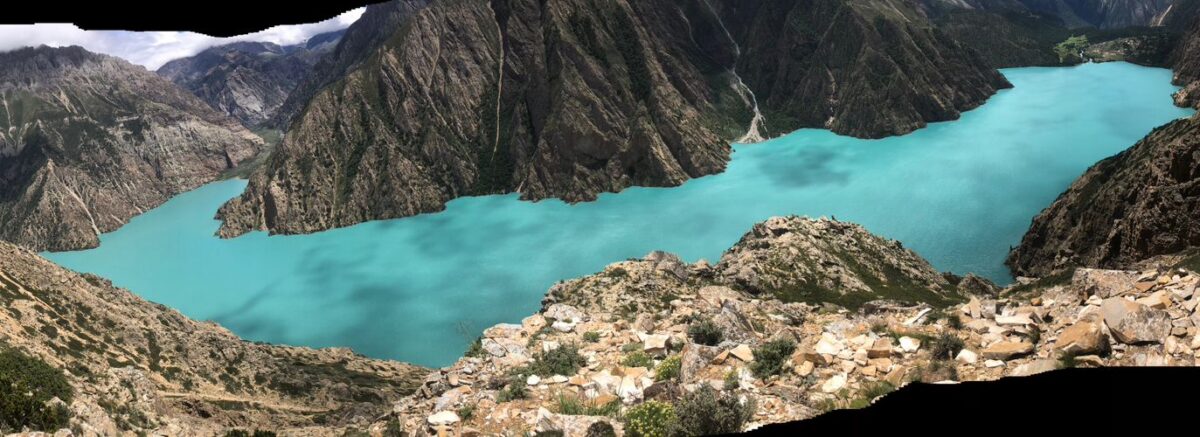
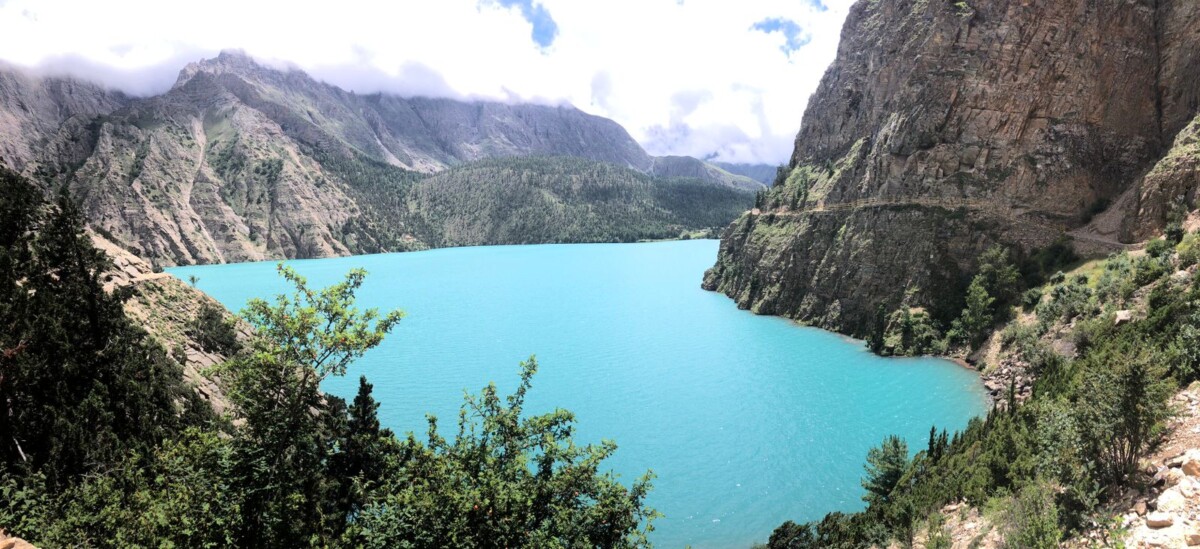
- See the beautiful turquoise waters of the Phoksundo Lake.
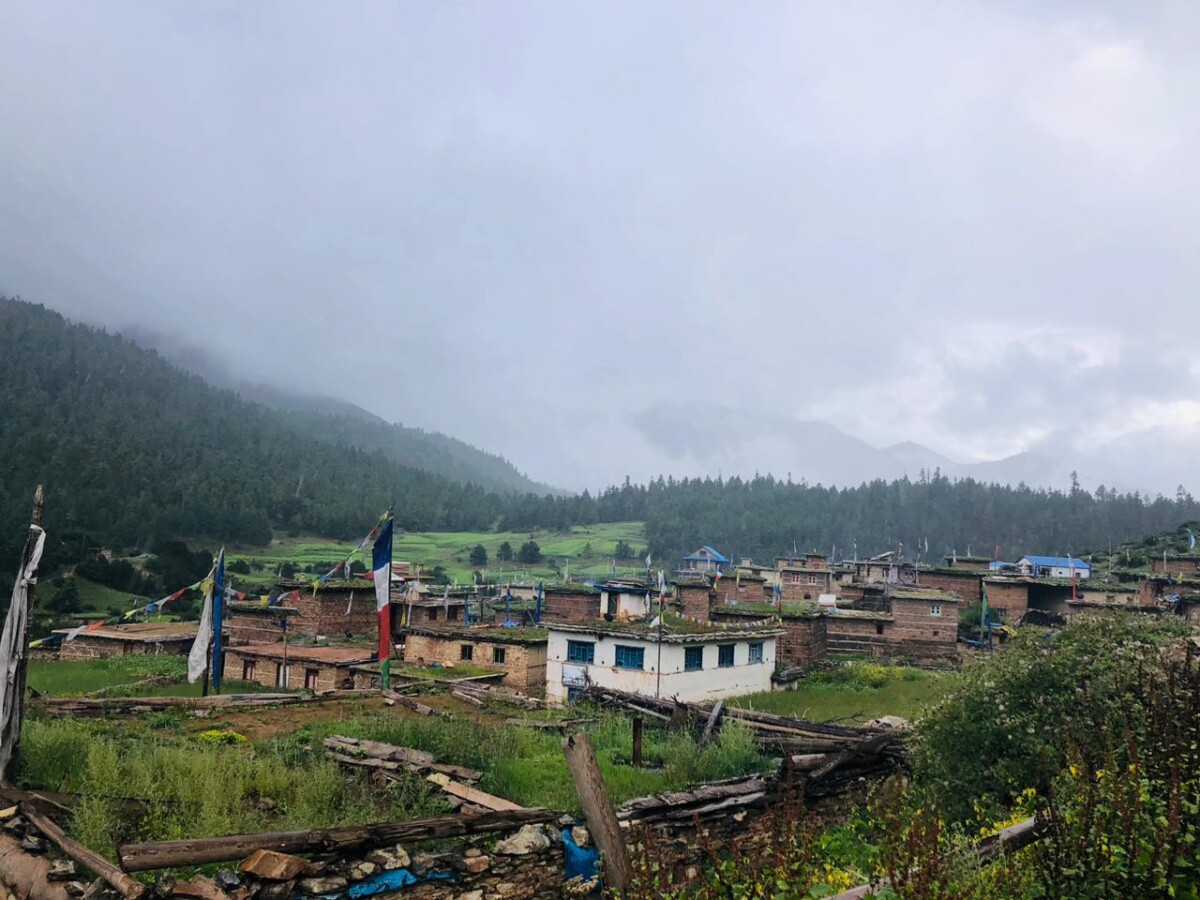
- Visit villages with a traditional Tibetan touch, such as Dho Tarap and Ringmo.
- Hike pristine sceneries within the Shey Phoksundo National Park.
- Take in dramatic mountain landscape, deep valleys, cliffs and alpine terrain.
Trip Overview of Lower Dolpo Trek – 18 Days
Lower Dolpo Trek is one of the most isolated and culturally diverse Nepal trekking adventure events, which provides a journey through by Glory Adventure the untouched Himalayan scenery, old villages, and high mountain passes. The Dolpo region is in western Nepal and is not as visited as the common trekking places, thus it is suitable for anyone who wants a less hectic and more genuine experience.
The journey blends both nature and culture, exploring deep valleys, alpine meadows, rugged cliffs and ancient villages that have been shaped by Tibetan culture.
The trip normally starts from Kathmandu to Nepalgunj by flight, then to Juphal, where the trekking begins. On the way, trekkers go through the villages of Dunai, Tarakot, Dho Tarap, Ringmo and the beautiful Phoksundo Lake area.
The highlights are the high passes such as Numa La (5,190 m / 17,027 ft) and Baga La (5,070 m / 16,633 ft) where stunning panoramic views of the mountains can be seen. Shey Phoksundo National Park, with its spectacular scenery, rare animals and untouched natural beauty, is also on the trail.
The Lower Dolpo Trek, unlike popular trekking trails, offers a true wilderness experience with serene trails and significant cultural experiences. Trekkers also spend their time in tea houses and tented camps based on the trail, and they get to enjoy the simplicity of life in the remote mountains. It is a physically challenging expedition whose benefits are outstanding among well-planned adventurers.
An organized itinerary of the Lower Dolpo Trek can assist in ensuring the right acclimatization, safe altitude gain, and the smooth trekking process. Although the cost of the Lower Dolpo Trek is usually more expensive than an ordinary tea house trek because of limited permits and remote logistics, the experience is special and makes it worth the price.
This trek can be a memorable Himalayan experience for any traveler who seeks an alternative to the mainstream trekking areas of Nepal with the appropriate seasoned operators like Glory Adventure.
Why This Trek?
The Lower Dolpo Trek is ideal for those who want to experience a remote Himalayan adventure without the hustle and bustle of trekking trails. It provides a unique blend of dramatic mountain landscapes, traditional village life, Tibetan-inspired culture and quiet wilderness. As compared to commercial trekking areas, Dolpo is untouched and really adventurous.
The main attractions are turquoise Phoksundo Lake, remote valleys, mountain passes, and cultural experiences in the villages, such as Dho Tarap. This is a good trek that requires experienced trekkers who seek a challenging and cultural experience. It is very rewarding despite the physical strain and remote locations of some parts of many of the routes due to the feeling of discovery.
In case you prefer a more genuine trekking adventure in Nepal and want to avoid the crowds, this adventure will provide you with something very special.
Trekking Route Overview
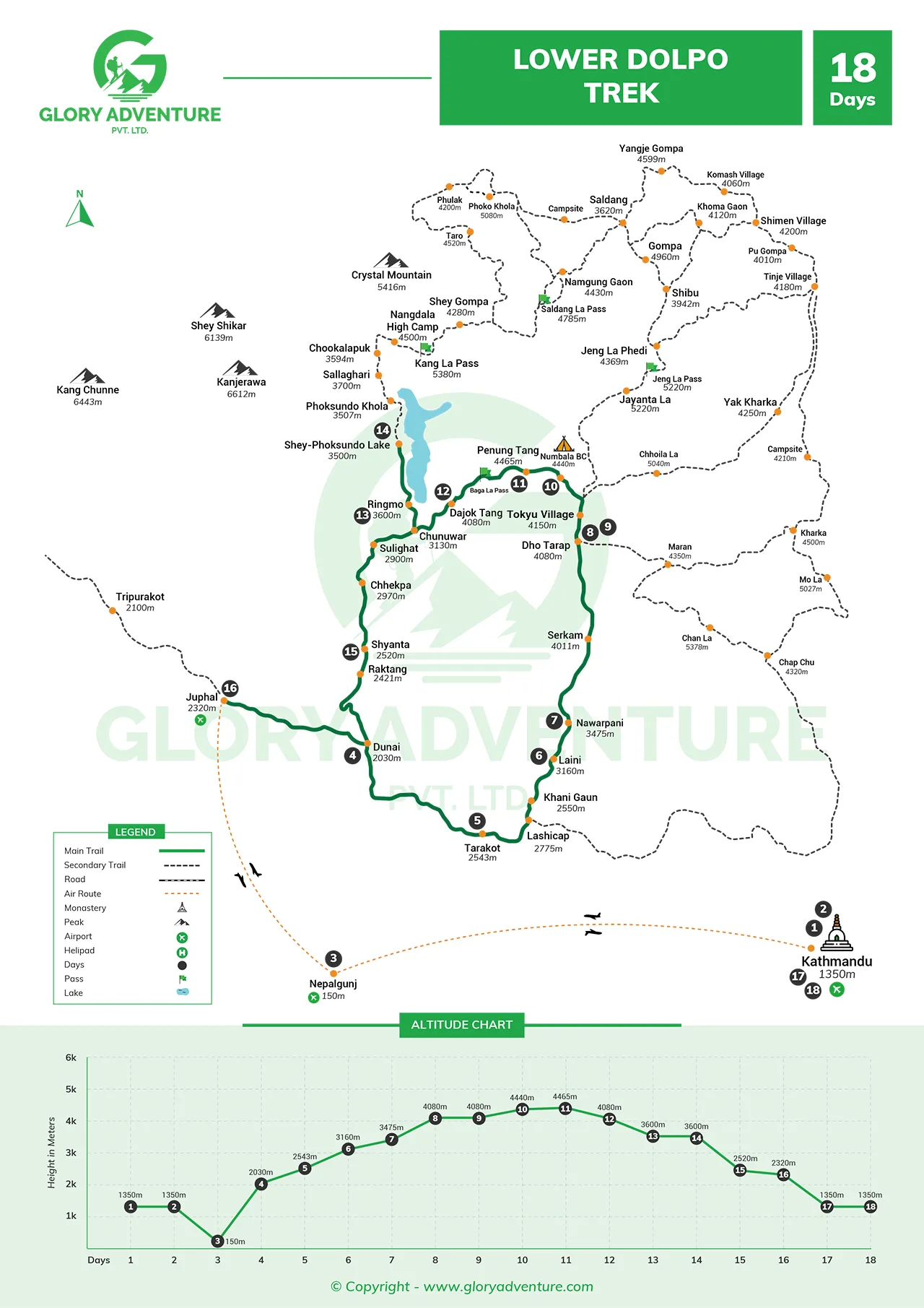
The Lower Dolpo Trek typically starts at Kathmandu, where flights are made to Nepalgunj and Juphal. Acclimatization is noteworthy at Juphal, where the trekking path goes past Dunai, Tarakot, Laini, Nawarpani, and Dho Tarap. The trail then continues toward Numa La Base Camp before crossing Numa La at (5,190 m / 17,027 ft) and Baga La at (5,070 m / 16,633 ft).
Following the pass crossings, the trail leads down towards Ringmo and the beautiful Phoksundo Lake region. The flight is made back with Shyanta and Juphal to fly back to Kathmandu. Being one of the most adventurous trekking experiences in Nepal, this route is a mixture of mountain wilderness, cultural villages, and the Himalayan dramatic views.
Itinerary of Lower Dolpo Trek – 18 Days
Day 01: Arrival in Kathmandu (1,400 m / 4,593 ft)
Once you arrive at Tribhuvan International Airport, you will be received and taken to your hotel in Thamel. You are able to rest and unwind after your trip. You will be briefed on the Lower Dolpo Trek itinerary and adventure later.
It is a leisurely day of preparation, during which you can relax before the trek. The capital of Nepal is Kathmandu (1,400 m / 4,593 ft), and the starting point of most Himalayan expeditions.
Your trip will include a welcome dinner, which will be held in the evening. We have no trekking scheduled today, so arrival, rest, and last preparations are the order of the day. This relaxed beginning helps you get used to it before heading to western Nepal to undertake the trekking adventure within the next few days.

Activity & Duration
Arrival and trek briefing
Highest Altitude
1400m / 4,593ft (Kathmandu)
Meals
Dinner
Accommodation
HotelDay 02: Lower Dolpo Trek Permit Preparation and Kathmandu Sightseeing
You will have a sightseeing tour of the major cultural sites of Kathmandu after breakfast. It starts with a trip to Pashupatinath Temple, which is among the most significant Hindu temples of Nepal.
There, you will proceed to Boudhanath Stupa, which is one of the biggest Buddhist stupas in the world. The next stop of the tour is Swayambhunath or Monkey Temple, after which Kathmandu Durbar Square, the ancient royal complex, is included.
These places are all UNESCO World Heritage sites and provide an understanding of Nepal’s culture, religion, and architecture. In the afternoon, you will meet your trekking guide and prepare last-minute arrangements to go on the Lower Dolpo trip. This is a day of sightseeing and preparing treks before you start your remote Himalayan trip.
Activity & Duration
Kathmandu sightseeing and trek preparation, Full dayHighest Altitude
1400m / 4,593ft (Kathmandu)Meals
BreakfastAccommodation
HotelDay 03: Flight from Kathmandu (1,400 m / 4,593 ft) to Nepalgunj (150 m / 492 ft)
The Lower Dolpo adventure will begin with a scenic domestic flight after breakfast in Kathmandu to Nepalgunj. This flight lasts approximately one hour and is worthwhile with a glance at the shifting landscapes of Nepal as you fly through the hills and the lowlands. Nepalgunj (150 m / 492 ft) is a busy city in western Nepal, and a key transit centre for flights into the Dolpo region.
Once there and checked into your hotel, you may rest or go about the local market and the surrounding areas. It is a lighter day that will put you nearer to the trekking area prior to the mountain adventure. It also allows you time to get ready for the early mountain flight, which is planned to take place the following morning.
Activity & Duration
Flight transfer, 1 Hour FlightHighest Altitude
150m / 492ft (Nepalgunj)Meals
BreakfastAccommodation
HotelDay 04: Flight from Nepalgunj (150 m / 492 ft) to Juphal (2,502 m / 8,208 ft), Trek to Dunai (2,850 m / 9,350 ft)
Today you start on your long walk. Following breakfast, you will have a scenic flight over the mountains in Nepalgunj to Juphal (2,502 m / 8,208 ft). The flight is a tour of beautiful aerial views of western Nepal and the mountains. Upon arrival, you will start walking to Dunai, the capital of Dolpo, which is at (2,850 m / 9,350 ft).
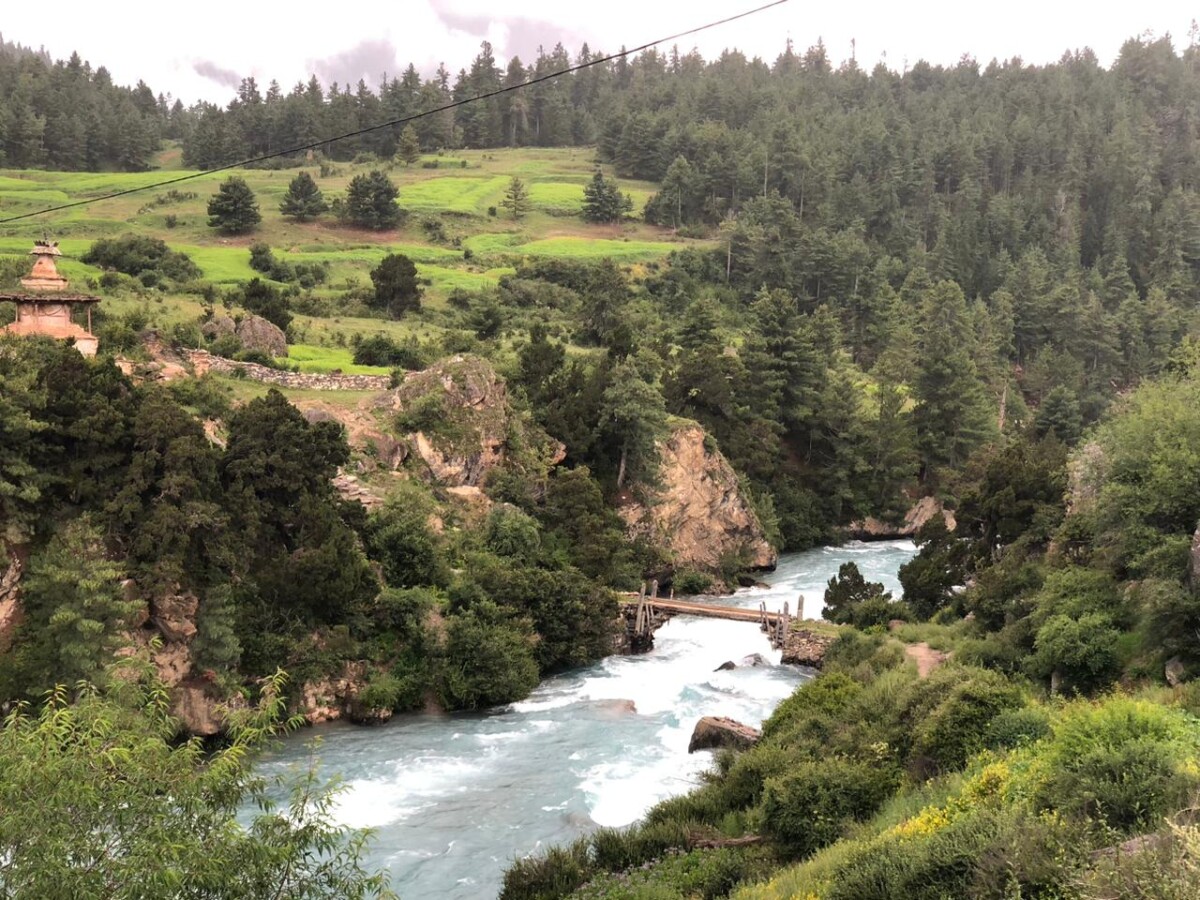
The route runs over terraced lands and small towns and crosses the Bheri River in the quiet rural landscape. This initial trekking day is more or less moderate, and it assists your body in starting to start adapting to higher altitude. Upon arrival at Dunai, you will spend the night in a tea house before resting to venture further into the remote parts of the Lower Dolpo trek.
Activity & Duration
Flight and trek, 45 Minutes Flight, then 2 to 3 Hours TrekHighest Altitude
2850m / 9,350ft (Dunai )Meals
Breakfast, Lunch, and DinnerAccommodation
TeahouseDay 05: Trek from Dunai (2,850 m / 9,350 ft) to Tarakot (2,543 m / 8,343 ft)
You will start after breakfast and will be trekking on the southern bank of the Bheri River at Dunai. The trail takes a scenic path over remote villages, narrow gorges, and hanging bridges to provide a real initiation into the rugged landscape of Lower Dolpo. The day contains a few medium-weight climbs and descents, but overall, it is not difficult and enables you to enjoy the view casually.
One of the former trading posts, Tarakot, is located on a hillside on the bank of the river at (2,543 m / 8,343 ft). The village is of historical value in the area and offers an overnight stay. The trail slowly brings you closer to civilization and more into the wilderness, as you get ready to take more distant trekking days in the future.
Activity & Duration
Trekking, 5 to 6 HoursHighest Altitude
2543m / 8,343ft (Tarakot)Meals
Breakfast, Lunch, and DinnerAccommodation
TeahouseDay 06: Trek from Tarakot (2,543 m / 8,343 ft) to Laini (3,160 m / 10,367 ft)
The present journey is along the Tarap Chu River and towards the further Dolpo area. The trail runs through isolated scenery after breakfast with numerous ups and downs. The path will take you over the river several times and through small villages and terraced farmlands. Among the interesting places along the way is that of Sandul Gompa, between the rivers Barbung Khola and Tarap Chu.
The landscape grows steeper and steeper as the path ascends higher up into the mountains. You will arrive at Laini (3,160 m / 10,367 ft) by the close of the day and spend the night in a tea house. A more challenging day of trekking as you ascend and advance toward the upper parts of the Lower Dolpo trail.
Activity & Duration
Trekking, 6 to 7 HoursHighest Altitude
3160m / 10,367ft (Laini)Meals
Breakfast, Lunch, and DinnerAccommodation
TeahouseDay 07: Trek from Laini (3,160 m / 10,367 ft) to Nawarpani (3,545 m / 11,630 ft)
This will be followed by a further trek into the Lower Dolpo region after breakfast. The path leads along the Tarap River through scenic scenery as the valley narrows and is increasingly rugged. Today you will be climbing up and down the rocks, so it will be a hard day physically, but it will be rewarding.
The canyon-like path will take you through the distant wilderness that is unique to Dolpo. On your way, you will cross Chyugur Khola and then head towards Nawarpani. This is a memorable part of the trek due to the peaceful environment and mountainous landscape. When you get to Nawarpani (3,545 m / 11,630 ft), you will stay the night in a tea house.
Activity & Duration
Trekking, 5 to 6 HoursHighest Altitude
3545m / 11,631ft (Nawarpani)Meals
Breakfast, Lunch, and DinnerAccommodation
TeahouseDay 08: Trek from Nawarpani (3,545 m / 11,630 ft) to Dho Tarap (4,090 m / 13,418 ft)
After breakfast, you will be walking into the gorgeous Upper Tarap Valley. It will be a slow ascent up to Kamattarka, at the junction of the Tarap Chu River and the Lang Khola. The landscape becomes different as you go on. The lower valley is greener and yields to the arid Himalayan inner country, where the juniper shrubs and wild roses are found growing on the trail.
The trail provides a dramatic change in the landscape and a more Tibetan cultural feel. In the afternoon, you will reach Dho Tarap, a traditional village with stone walls at (4,090 m / 13,418 ft). This distant village has a culture and mountain lifestyle of its own. Due to the high increase in altitude, today is a major acclimatization day before going over higher mountain passes in the later part of the trek.
Activity & Duration
Trekking, 7 to 8 HoursHighest Altitude
4090m / 13,419ft (Dho Tarap )Meals
Breakfast, Lunch and DinnerAccommodation
TeahouseDay 09: Acclimatization Day in Dho Tarap (4,090 m / 13,418 ft)
Today is a significant acclimatization day in Dho Tarap to ensure that your body adjusts to the elevated altitude. Such rest days are necessary when trekking in high altitudes to minimize the chances of altitude sickness. You will not have to rest all the time, but you can use the day to explore the village and its surroundings in a relaxed manner. Dho Tarap is among the most permanent settlements in Nepal and provides an interesting insight into life in remote Himalayan areas.
You can socialize with the local people, get to know the local way of life, and get to know the local culture and religious beliefs, such as the Bon and Buddhist cultures. The experience is enhanced by the mountainous landscape around. The day will permit physical rest and cultural exploration, prior to the tougher pass crossings that await in the subsequent trekking days.
Activity & Duration
Acclimatization and local exploration, Full dayHighest Altitude
4090m / 13,419ft (Dho Tarap )Meals
Breakfast, Lunch and DinnerAccommodation
TeahouseDay 10: Trek from Dho Tarap (4,090 m / 13,418 ft) to Numa La Base Camp (4,440 m / 14,566 ft)
You will leave Dho Tarap after breakfast and enter the upper valley. The path is along the Tarap Chu River in open country with grassy fields and lovely mountainous scenery. This more subdued part of the journey seems isolated and serene, with fewer places of human habitation on the path. The higher you are, the more difficult the land, and the thinner the air.
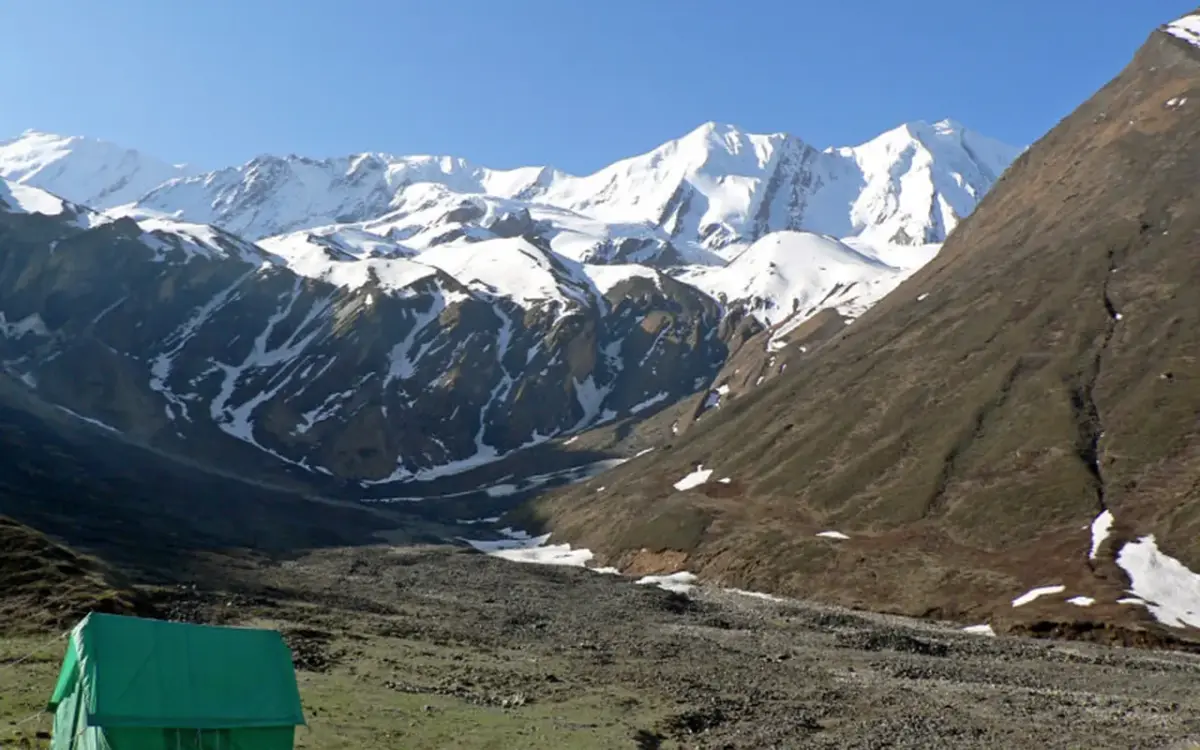
The slow ascent is a way of getting your body ready to tackle the strenuous pass that is to come. At the end of the day, you will be in Numa La Base Camp at (4,440 m / 14,566 ft), where you will be camping in a tent. This night’s rest has put you in an excellent position tomorrow to make your way over Numa La Pass. Fare thee well, it is one of the hardest days of the trek.
Activity & Duration
Trekking, 6 to 7 HoursHighest Altitude
4440m / 14,567ft (Numa La Base Camp)Meals
Breakfast, Lunch, and DinnerAccommodation
TentDay 11: Trek from Numa La Base Camp (4,440 m / 14,566 ft) to Pelung Tang (4,465 m / 14,648 ft) via Numa La Pass (5,190 m / 17,027 ft)
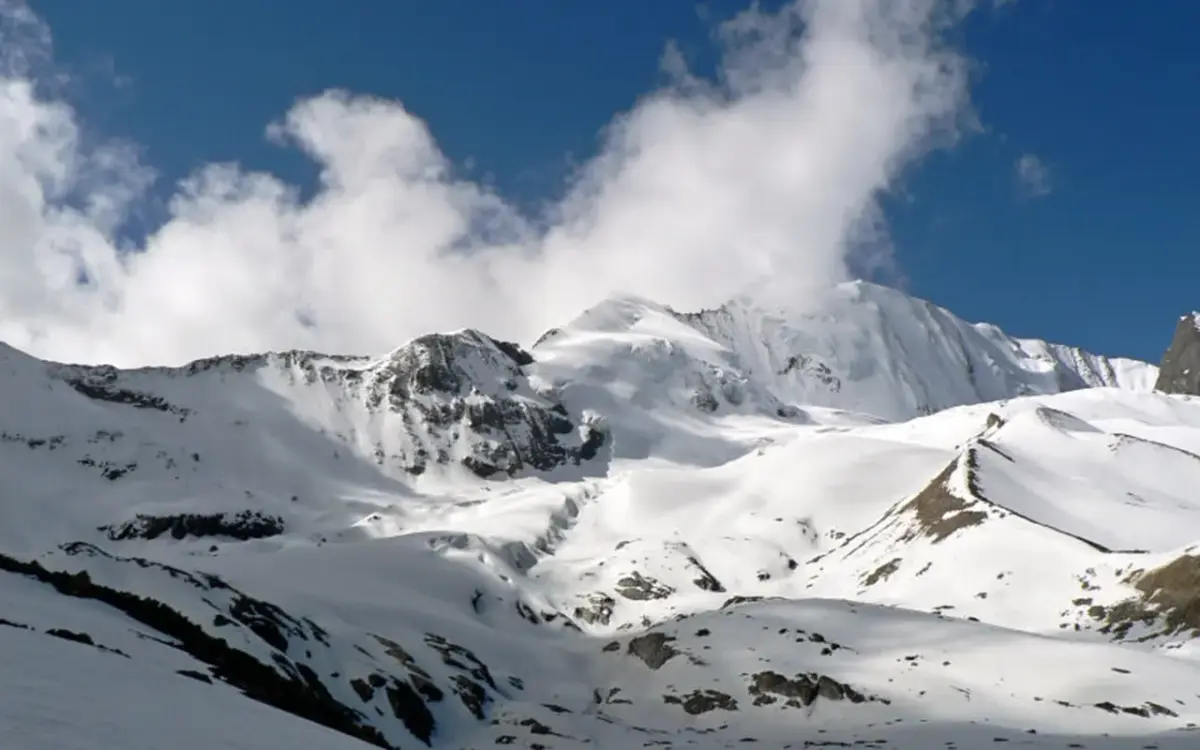
Today is one of the most challenging and rewarding days of the trek. You will then start the difficult climb to the top of Numa La Pass at (5,190 m / 17,027 ft), the highest point of the day, after having had an early breakfast. It is a strenuous climb, but the view is worth it as the whole Dolpo mountains surround them, with a distant glimpse of Dhaulagiri. You will then start a lengthy downhill journey over rocky terrain to Pelung Tang after a stay at the pass.
The trail is narrow and should be stepped on steadily and with care because of the height and the ground. A tented camp will be your portion as you approach Pelung Tang at (4,465 m / 14,648 ft). It is a big day of achievement, combining physical challenge, high altitude trekking and incomparable Himalayan scenery.
Activity & Duration
Trekking via high pass, 6 to 7 HoursHighest Altitude
5190m / 17,028ft (Numa La Pass)Meals
Breakfast, Lunch and DinnerAccommodation
TentDay 12: Trek from Pelung Tang (4,465 m / 14,648 ft) to Dajok Tang (4,080 m / 13,385 ft) via Baga La Pass (5,070 m / 16,633 ft)
Following breakfast, you will embark on another difficult day of trekking as you approach Baga La Pass at (5,070 m / 16,633 ft). Climbing is strenuous and involves gradual effort, but the mountain views render the climb pleasurable. At the summit, you will get panoramic views of the arid Dolpo Valley, the far snow-capped mountains, and the arresting Himalayan wilderness.
You will have spent some time at the pass, and down the steep mountain tracks, you will carefully come to Dajok Tang. The distance is physically exhausting due to the elevation and constant ups and downs, thus a slow pace is significant. In the evening, you will come to Dajok Tang and spend the night at (4,080 m / 13,385 ft). Here is the other memorable high altitude day in the remote and beautiful Dolpo region.
Activity & Duration
Trekking via high pass, 6 HoursHighest Altitude
5070m / 16,634ft (Baga La Pass)Meals
Breakfast, Lunch and DinnerAccommodation
TeahouseDay 13: Trek from Dajok Tang (4,080 m / 13,385 ft) to Ringmo (3,600 m / 11,811 ft)
The current trek is not as difficult as the past strenuous crossings of the passes. Following breakfast, you will go through beautiful alpine sceneries, the changing scenery that follows is inclusive of open mountain terrain, green vegetation, as well as pine forests. The path will provide a cool breeze after the dry high altitude areas that have been passed during the trek. As one goes further down, the air is cooler, so the day is not as physically challenging.
In the afternoon, you will reach Ringmo, a typical village of the Dolpo region (3,600 m / 11,811 ft). This camp is a good representation of Tibetan culture and also a good place to relax after some tough trekking days. Tonight you will be staying in a tea house and make the arrangements for your visit to the renowned Phoksundo Lake region tomorrow.
Activity & Duration
Trekking, 3 to 4 HoursHighest Altitude
4080m / 13,386ft (Dajok Tang)Meals
Breakfast, Lunch and DinnerAccommodation
TeahouseDay 14: Trek from Ringmo (3,600 m / 11,811 ft) to Phoksundo Lake (3,611 m / 11,847 ft)
Then, after having breakfast, you will have a short yet unforgettable trip to Phoksundo Lake at (3,611 m / 11,847 ft), one of the most beautiful natural sites in Nepal. It is a scenic trek with mountainous views and calmness as you head towards the lake. On the route, you can see local villages, caravans of yaks and the traditional mountain life that represents the nature of the Dolpo region.
It will greet you with the magnificent turquoise waters of the Phoksundo Lake, with its spectacular mountain and cliff setting. It is also one of the highlights of the whole trek and a great chance to have a rest and enjoy the remote Himalayan setting. You will stay in a tea house by the lake, taking in the relaxing environment and getting ready to descend in the days to come.
Activity & Duration
Trekking, 2 to 3 HoursHighest Altitude
3611m / 11,847ft (Phoksundo Lake)Meals
Breakfast, Lunch and DinnerAccommodation
TeahouseDay 15: Trek from Phoksundo Lake (3,611 m / 11,847 ft) to Shyanta (2,520 m / 8,267 ft)
After breakfast, you will start a long descent of the Phoksundo Lake area towards Shyanta. The path has varied sceneries such as rocky routes, forested areas and mountain hamlets. On your way down, you will be out of the high alpine region into lower terrain with warmer weather. The route includes some dramatic cliffside sections, where the views of the surrounding valleys are memorable.
It is a long, yet satisfying day, retracing part of the trail through the beautiful Dolpo landscape. In the evening, you will reach Shyanta at (2,520 m / 8,267 ft) and spend the night in a tea house. This descent will ease the burden of the elevation and will be the start of your journey back to Juphal and finishing the trekking adventure.
Activity & Duration
Trekking, 7 to 8 HoursHighest Altitude
3611m / 11,847ft (Phoksundo Lake)Meals
Breakfast, Lunch, and DinnerAccommodation
TeahouseDay 16: Trek from Shyanta (2,520 m / 8,267 ft) to Juphal (2,320 m / 7,611 ft)
You will proceed in the morning after breakfast to Juphal. The trail is located in scenic lower mountainous terrain, featuring the sights of forests, villages, and the hills. Relative to the more challenging high mountain parts of the trek above, today is not so challenging, but the hours of walking are long. The path gives you time to look back as you trek into Dolpo through the remote landscapes towards your last trekking point.
You will go by Sulighat, and on the same path, you will proceed to Juphal, which you have seen. On reaching the Juphal (2,320 m / 7,611 ft), you can sleep and have your last evening in the trekking area. This will be the concluding part of your walking around Dolpo trip before you are brought back to Kathmandu by plane.
Activity & Duration
Trekking, 7 to 8 HoursHighest Altitude
2520m / 8,268ft (Shyanta)Meals
Breakfast, Lunch, and DinnerAccommodation
TeahouseDay 17: Flight from Juphal (2,320 m / 7,611 ft) to Nepalgunj (150 m / 492 ft), then Kathmandu (1,400 m / 4,593 ft)
You will depart the Dolpo region after breakfast and will start the flight back. The first one is that you will go on a mountain flight, Juphal to Nepalgunj, and a domestic flight to Kathmandu. The ride provides a last opportunity to experience aerial sightseeing of the Nepal scenic topography, of the remote mountainous region, to the lower plains, and eventually Kathmandu Valley.
Upon reaching Kathmandu, you will be taken to your hotel, and you can rest after a long day of traveling. The evening will be spent having a farewell dinner to celebrate the successful end of the Lower Dolpo adventure. This is the last official day of the trekking adventure, and you have time to unwind, reflect, and get ready to head to a foreign country the next day.
Activity & Duration
Flight transfer, Flight transfer dayHighest Altitude
2320m / 7,612ft (Juphal)Meals
Breakfast and Farewell DinnerAccommodation
HotelDay 18: Final Departure
You will then leave Kathmandu and your hotel and get ready to leave after breakfast. Your flight will be scheduled to Tribhuvan International Airport, where a transfer will be granted. This day is the last day of your Lower Dolpo venture in Nepal. Depending on your time of departure, you might have some time to do final packing, relax, or look back at the memorable experiences of the trek.
The trip brings with it long-term memories of the cultural sights in Kathmandu, the secluded valleys, mountain ranges, the village life of the traditional people, and the breathtaking scenery of the Phoksundo Lake. You will be taken to the airport, where you will do departure formalities and board your international flight home. The end of your magnificent Himalayan adventure has arrived today, and with it, you have carried with you memorable trekking memories.
Activity & Duration
Final departure, Airport transferHighest Altitude
1400m / 4,593ft (Kathmandu)Meals
BreakfastIncludes / Excludes of Lower Dolpo Trek – 18 Days
What is included?
- Pick-up and drop off at the airport.
- Kathmandu and Nepalgunj hotel, including breakfast.
- Domestic flights as per itinerary
- Restricted area, Shey Phoksundo National Park permit and TIMS card (if required)
- Paperwork and taxes of the government.
- Certified trekking guide and porter.
- Guide/porter meals, stay, salary, and insurance
- Tea house and tented accommodation needed.
- Three meals in trekking.
- Welcome and farewell dinner
- Basic first-aid support
- Trek briefing before departure.
What is excluded?
- International airfare
- Nepal visa fees
- Travel insurance and rescue in case of emergency.
- Personal trekking gear
- Personal expenses and beverages.
- Extra hotel nights due to delays
- Hot shower, internet and charging fees.
- Medical costs that are not covered by insurance.
- Staff tips
- Anything not listed includes
Route Map & Altitude Chart
Essential Information of Lower Dolpo Trek – 18 Days
Weather and Best Season
The best season of the Lower Dolpo Trek is spring (March to May) and autumn (September to November). These seasons tend to be at the same time more stable in weather, the sky is clearer, the mountain is seen better, and trekking is much safer and more pleasant. Moderate temperatures, blooms, and pleasant walking are best enjoyed in the spring, whereas dry trails and cool mountain vistas can be found in the fall. It is a very cold winter, and it is even worse in the high parts of the country like Numa La Pass (5,190 m / 17,027 ft), where deep snow can block the path.
The monsoon season is not so ideal, as there is also rain and potential delay in travelling, but Dolpo does not receive so much rainfall since it is located in a rain shadow region. When planning the Lower Dolpo Trek itinerary, selecting the proper season significantly enhances your trekking experience and minimises the number of weather-related difficulties in this remote area of the Himalayas.
Difficulty and Altitude Sickness
Lower Dolpo Trek is described as a difficult adventure due to its remote location, elevated altitude, and lengthy hours of trekking. You will trek several hours per day along mountainous trails with rough conditions, traverse steep passages, and be accommodated in simple facilities. Altitude sickness is one of the greatest obstacles, particularly when trekking above 5,000 m / 16,404 ft, such as Baga La Pass (5,070 m / 16,633 ft). Symptoms such as headache, nausea, dizziness, tiredness, and breathing discomfort are common.
It is extremely essential to have a gradual pace and adequate acclimatization. A carefully designed Lower Dolpo Trek schedule will consist of rest days to allow your body time to adapt. Although the trek does not involve any technical climbing skills, it involves stamina, patience, and strength of mind. When the guide notices that the symptoms of altitude sickness start to become worse, trekkers should notify their guide immediately.
Insurance, Visa, and Permits for the Trip
Proper travel documents and insurance are needed before beginning the Lower Dolpo Trek. The majority of foreign tourists require a tourist visa to Nepal, which can be either acquired at the entrance of Kathmandu or pre-booked. Lower Dolpo is a restricted trekking area and thus, special permits are mandatory. They usually consist of a Restricted Area Permit and a Shey Phoksundo National Park entry permit. The processing of permits should be done by a registered trekking agency.
Travel insurance is highly advisable due to the remoteness and altitude of the trek. The following should be a part of your policy: trekking above (5,000 m / 16,404 ft) and emergency medical care, as well as helicopter evacuation in case of necessity. Before embarking on this challenging adventure in the Himalayas, Glory Adventure can assist in preparing the permit and give advice on the necessary documentation before starting this arduous process.
Training, Fitness Level & Mental Preparation
The Lower Dolpo Trek is a trek that requires good preparation to be accomplished. This route includes many days of walking for six to eight hours over uneven terrain, steep climbs, and high mountain passes. Pre-trip exercise, leg-strength workouts, cardio exercise, and hiking practice, including climbing stairs, are beneficial. You can also train with a loaded backpack to allow your body to get used to the trekking conditions. Mental preparedness is also necessary since weather delays, bodily exhaustion, and mere mountain amenities are also included in the experience.
Lower Dolpo Trek price is a big investment, and hence proper preparations enable you to have fun during the expedition. Remote Himalayan trekking may be a mental challenge even for strong trekkers. Being patient, flexible, and positive even in the tough times makes the process far easier and builds confidence in you throughout the adventure.
Risk Factors on the Trek
Similar to any trek in remote mountains, the Lower Dolpo Trek also involves several risks that the travelers ought to be aware of prior to going out. The most important factor to take into account is still the high altitude when passing over (5,000 m / 16,404 ft). Unpredictable weather can cause disruption of flights or routes. Trekking tracks are steep, rocky, and physically demanding, which heightens the risk of slipping or getting tired. Even minor health problems are reported to be more serious due to the lack of medical facilities in remote Dolpo.
Isolated villages can have basic food options, accommodation facilities, and communication services. Hiking under the guidance of seasoned leaders is a great way of enhancing safety and decision-making. Most dangers are minimized by proper acclimatization, insurance cover, realistic expectations and physical preparation. Despite the challenging nature of the Lower Dolpo Trek, with proper planning and trekking ethics, the trek will be a fulfilling and achievable experience.
Health & Safety
Health and safety must be a priority in the Lower Dolpo Trek due to the remote nature of the terrain and high-altitude environment. Consumption of sufficient water, proper food, and walking at a moderate pace are useful in keeping you active and minimizing the issues of the altitude.It is advisable to have a personal first-aid kit consisting of simple medicines against headaches, stomach problems, blisters, and cold symptoms.
Dolpo has only medical posts in remote areas, so prevention is of the essence. Take the advice of your guide as to acclimatization and rest. Hygiene is also important when sharing tea house facilities. In case of serious symptoms like difficulty in breathing, chest pain, or severe dizziness, prompt action is required. The decision to use a reputable trekking firm like Glory Adventure provides additional safety in terms of expert guidance, adequate logistics, and emergency back-up arrangements.
Transportation
The Lower Dolpo Trek transportation typically involves road transportation and domestic flights, which depend on the ultimate plan. The majority of the trips start in Kathmandu and continue with a domestic flight to Nepalgunj. Another mountain flight transports the trekkers to Juphal, which is the common trekking base. These flights are time-saving, but can also be delayed by weather conditions in mountainous areas.
In Kathmandu, road transport is usually by personal car to and from the airport, sightseeing, or moving to and out of a hotel. Due to the remoteness of Lower Dolpo, there are few means of transport compared to the other, more frequented trekking areas. Travelers ought to have some additional time to spare in their schedule in case of delays. Easy transportation and adaptability in planning can ease tension and ensure that the start and end of the trek are a lot easier for international visitors.
Your Extra Expenses
In addition to the price of the package, trekkers must be able to afford their own expenses when undertaking the Lower Dolpo Trek. Additional expenses can be international flights, Nepal visa charges, travel insurance, snacks, bottled water, hot showers, charges, internet connectivity, guides, and porters’ tips, and Kathmandu personal shopping. Drinks like tea, coffee, soft drinks, or alcoholic beverages might also be an additional expense in tea houses.
Flight delays may also result in emergency costs or additional hotel stays. The logistics of remote trekking are costly, and thus the cost of personal purchases in the mountains is usually higher than in cities. Knowing these extra costs will assist travelers in better budget management. Budgeting beyond the bare minimum for the Lower Dolpo Trek will save unexpected costs and ensure a more comfortable trekking experience throughout.
Language & Communication
The national language of Nepal is Nepali, but the local communities of the Dolpo region can use dialects influenced by Tibetan, in addition to Nepali. On the lower Dolpo trek, some simple communication in English can be expected with trekking guides and staff, particularly in the case of organized groups. There might be little English in the small village, and a simple conversation and patience can help. It is possible to learn some Nepali greetings that may establish friendly relations with local people. Respectful communication is important when visiting culturally traditional communities.
Since the walk cuts across remote areas, getting in touch with people may be challenging beyond large communities. Your guide is frequently the key intermediary between the travelers and the local communities. Guiding with a seasoned team will help to eliminate any confusion and enhance the cultural experience, which will make your experience in Lower Dolpo less hectic and enjoyable.
Mobile Network, Internet & Charging Facilities
The connectivity via mobile in the Lower Dolpo Trek may not be found to be reliable due to the remoteness of the area and mountainous nature. In some of the lower villages, network coverage might exist, but in higher, elevated, and remote areas, the network tends to become weak or even nonexistent. Where available, internet access is slow, and in most cases, an additional fee at tea houses is required. Electronic devices can also be charged in selected accommodation stops, although power access might be restricted, and additional charges are usually charged.
It is highly advised to carry a power bank or a spare battery. As communication can take several days before it resumes, it is advisable to notify the family before the trek. Mobile internet should not be used by travellers with complete reliance on communication or navigation. Limited connectivity is a plus as it prepares one for what to expect and limits the amount of unneeded stress that may result in the trip.
Don’ts on This Trip
The Lower Dolpo Trek has a number of things that should be avoided in order to have a safe and respectful experience. Do not walk too fast, particularly at high altitude, because this will predispose the individual to altitude sickness. The excessive consumption of alcohol in high altitudes should be avoided since it may increase dehydration and slow down the process of acclimatization. Dispose of plastic waste materials and litter on the trail because it is significant to take care of the delicate mountain environment. Do not take photos of local individuals, monasteries, or religious rituals without their consent.
Symptoms like severe headache, nausea, or difficulty in breathing should not be overlooked. Show dignity to the local traditions, dress up decently, and do not interfere with the village lifestyle. This is an isolated trekking area, and thus, reckless decision-making can cause severe issues. It is important to act responsibly to ensure that the Lower Dolpo Trek is safer, smoother, and enjoyable to all who are on the trail.
Cultural Festivals on the Trail
Dolpo has a strong cultural background due to the Tibetan Buddhism culture and traditions, and the ancient mountain life. When the traveler is on the Lower Dolpo Trek, the traveler can get the chance to observe the local religious rituals, monastery meetings, and seasonal celebrations, depending on the date of the trek.The traditional music, masked dances, prayer ceremonies, and community events often form part of the festivals and are a depiction of the spiritual identity of the region. There are also villages like Dho Tarap and Ringmo that are more cultural due to the traditions that they uphold.
Precise timing of the festivals is based on the lunar calendar, and therefore, yearly, there can be changes in the dates. When the religious events are going on, trekkers are expected to respect and obey the local advice. The added cultural value to the physical adventure is the experience of these traditions.The Lower Dolpo Trek is not merely about mountain landscape, but it is also about learning about one of the most distinct Himalayan cultures in Nepal.
Tips for First-Time Nepal Visitors
This is your first time in Nepal, and proper preparation will make your trekking experience easier and enjoyable. Bring a local money supply since most of the remote places do not accept card payments. Wear multiple layers, because the weather may vary rapidly between the lower villages and the higher passes, such as Numa La at (5,190 m / 17,027 ft).Adhere to local traditions, take off your shoes when entering a sacred site, and shake hands in a polite manner.
Consume clean water and do not take food that you have no idea about carelessly to minimize stomach issues. Weather delays can be experienced during domestic flights in Nepal, and hence, flexible planning can be useful. With the Lower Dolpo Trek being your first major expedition to the Himalayas, it really does matter whether you hire an experienced support or not.Nepal is a place with fantastic views and hospitable people, and appropriate preparation is the key to the perfect first trekking experience.
Frequently Asked Question (FAQ’s)
No, Lower Dolpo is a restricted region, and trekking has to be organized by a registered agency, complete with the necessary permits and guide assistance.
Some high-altitude trekking experience in the past can be beneficial, but well-prepared beginners are also able to complete the trek with correct guidance.
Yes, there are usually vegetarian foods in tea houses and camps during the trek.
It is usually advised to carry a range of 2 to 3 liters of water per day, so it can be based on the weather and the difficulty of the walk.
No, there are no ATM services on the trekking route; therefore, bring enough local cash with you.
It is highly recommended to have a good sleeping bag that is designed to withstand cold weather in the mountains.
Yes, individual travelers may sometimes get included in group departures when there are such.
Delays in weather can occur, and it would be advisable to have a few spare buffer days in your travel schedule.
Power can be restricted and may be charged at certain stops, typically at an additional fee.
Some may have hot showers at an extra charge, but not all.
The area has wildlife, including blue sheep, Himalayan birds and other mountain species.
Yes, changes in the itinerary can be made based on time, permits and logistics.
Trip Reviews on Lower Dolpo Trek – 18 Days

Price starts from
US$ 2600
For group of minimum 3 Pax
US$ 2800
Need Help?
Managing Director
Saroj (+977-9806627713)
Saroj Sunar
Travel Consultant
Looking for a Private Trip?
Say Hello to Your Travel Consultant
Planning your next getaway? Our travel specialists are ready to design a fully customized package tailored to your interests. If you need help or have any questions, feel free to connect with us—we’re here to guide you from start to finish.
Price starts
US$ 2600
✖
Free Trip Planner
Talk to
Mr. Saroj Sunar