 Talk to Mr. Saroj
- Home
- Destination
- Nepal Trekking
- Annapurna Region
- Short Poon Hill Trek 3 Days
- Ghorepani Poon Hill Trek 4 Days
- Ghorepani Poon Hill Trek – 8 Days
- Annapurna Base Camp Heli Trek
- Short Annapurna Base Camp Trek- 6 Days
- Annapurna Base Camp Trek – 10 Days
- Annapurna Base Camp Trek Via poon Hill
- Short Mardi Himal Trek
- Mardi Himal Trek – 10 Days
- Ghorepani Poon Hill with Mardi Himal Trek
- Short Annapurna Circuit Trek
- Annapurna Circuit Trek with Tilicho Lake
- Annapurna North Base Camp Trek– 9 Days
- Khopra Ridge Trek
- Mohare Danda Trek – 9 Days
- Kori Himal Trek -10 Days
- Nar Phu Valley Trek with Kang La and Thorong La Pass- 17 Days
- Annapurna Region
- Travel Info
- Company
- Contact
 English
 Malay
Malay Dutch
Dutch Japanese
 Hindi
Hindi Italian
 Spanish
 French
 German
 Chinese
 Korean
 Arabic
 Hebrew
 Russian
 Portuguese
 Danish
 Czech
Czech Polish
 Swedish
 Plan Your Trip
 Bookings open for the 2026-2027 season! Start planning your dream journey.
Tiji Festival in Upper Mustang

Kagbeni Village
Price starts from
US$ 2137
For group of minimum 3 Pax
Group Discount Price
- 1 personUS$ 2250
- 2 - 5 personUS$ 2137
- 6 - 8 personUS$ 2025
- 9 - 14 personUS$ 1912
- 15 over 9999 US$ 1800
US$ 2250
Need Help? 
Managing Director Saroj (+977-9806627713)

Duration
17 Days

Trip Difficulty
Moderate

Max Altitude
3,960m / 12,992ft

Activity
Trekking

Destination
Nepal

Group Size
2-16 People

Meals
Breakfast, Lunch, Dinner

Transportation
Flight, Bus
Highlights of Tiji Festival in Upper Mustang
- Experience the vibrant and interesting Tiji festival for 3 whole days.
- Visit many gompas throughout the trek, notably Luri Gompa, Nyphu Gompa, and Ghar Gompa.
- Trek through remote highland villages offering scenic trails and pristine nature.
- Explore the Chhoser Cave along with the Chungsi Rangjung Cave Monastery.
- Cross a couple of mountain passes to enjoy panoramic views of the nearby peaks.
Trip Overview of Tiji Festival in Upper Mustang
The Tiji Festival in Upper Mustang is one of the most authentic Himalayan trekking experiences that one can go for. The festival is deeply rooted in Tibetan Buddhism, following a story about Dorje Jono’s battle with the demons, which has been passed down through generations. The Upper Mustang region has been given the moniker Last Forbidden Kingdom as it was forbidden for outsiders to visit the region. They lifted the ban in 1992 and only allowed a certain number of visitors per year.
The Upper Mustang region is one of the sparsely populated regions of Nepal, with a population of under 6000. One of the reasons for that is the extreme weather conditions, which can reach –20 °C in the winter season. However, the daytime and nighttime temperatures during spring, autumn, and summer seasons are very tolerable. Another reason for its low population is accessibility, while it is fairly accessible on foot, vehicles have yet to reach the highlands.
The walled city of Lo Manthang is the main destination of this Tiji Festival in Upper Mustang trek, since it is the host of the Tiji Festival. There, we will visit the Lo Palace, Thubchen monastery, and Jampa Lhakhang. Along the route, we will visit many other gompa sites, pass by many chortens and mani walls. Monasteries, including Ghar Gompa, Luri Gompa, Chungsi cave, and more, are included in our itinerary.
The 3-day festival of Tiji features masked dance rituals performed by monks. This festival dates back to the 17th century, a product of Tibetan Buddhism folklore. After enjoying the festival, we will drive you to Mukitnath, one of the most sacred temples for Hindus and Buddhists. All in all, this trek is a great way to experience the culture of the Himalayas and explore the arid highlands of Upper Mustang.
Itinerary of Tiji Festival in Upper Mustang
Day 01: Arrival in Kathmandu
The first day of the Tiji Festival in Upper Mustang trek requires us to arrive in Kathmandu, the capital of Nepal. Your flight to Kathmandu will be a scenic one as you will be able to see a bunch of peaks in the north. After landing at the airport, you will be directed towards the immigration section, where you will get your tourist visa.
You will have to submit your visa application form along with your passport, two passport-sized photos, proof of stay, return tickets, and a visa fee payment slip. You can ask for a visa application form at the counter. After filling it out, you should pay your visa fees at the bank counter nearby. You will be given a receipt for it. While international forms of card payments are accepted, it might not work at times, so you should always carry enough cash.
After about an hour, you will have your visa stamped. Finally, you can leave the airport; you will find one of our reps waiting for you outside the terminal. He will greet you and take you to your hotel for the night.

Activity & Duration
30 mins drive to hotel
Highest Altitude
1350m / 4,429ft (Kathmandu )
Meals
-
Accommodation
Three star Hotel in kathmanduDay 02: Full day Sightseeing tour around Kathmandu valley
Sightseeing in Kathmandu Valley is a great way to start your journey in Nepal. On the 2nd of the Tiji Festival in Upper Mustang trek, we will take you to visit some historic and religious sites within Kathmandu Valley. The day tour starts with a morning visit to Swayambhunath Stupa. We will climb the 365 steps, representing each day of the year. After this, we will visit Bouddhnath Stupa, a 5th-century stupa.
After lunch at one of your preferred eateries, we will visit Pashupatinath Temple. This Hindu temple is one of the most sacred sites for followers. Our next stop is Kathmandu Durbar Square, a great complex with many temples, a royal palace, and a house for the only Living Goddess in Nepal. Moving on, we will visit many attractions within the valley before calling it a day.
Activity & Duration
Full day Sightseeing tour around Kathmandu valleyHighest Altitude
1350m / 4,429ft (Kathmandu)Meals
BreakfastAccommodation
Three star Hotel in kathmanduDay 03: Drive from Kathmandu to Pokhara
Today, we will drive from Kathmandu to Pokhara, which takes about 8 hours. Leaving Kathmandu after breakfast, we will climb up a switchback road to get to Naubise. From there, we will join the Prithvi Highway that connects Pokhara and Kathmandu. Passing Malekhu, Dumre, Kurintar, and Lekhnath, we will finally reach Pokhara city.
We will have our lunch at one of the highway restaurants, and your hotel for the night will be near the serene Phewa Lake. You can take a relaxing walk by the lake in the evening hours and also get a little taste of Pokhara’s vibrant nightlife.
Activity & Duration
Drive from Kathmandu to Pokhara 6 to 7 hoursHighest Altitude
822m / 2,697ft (Pokhara )Meals
BreakfastAccommodation
Three Star Hotel in PokharaDay 04: Fly from Pokhara to Jomsom and trek to Lubra/Lupra village
On the 4th day of the Tiji Festival in Upper Mustang trek, we will leave Pokhara and get on a flight to Jomsom. This 20-minute flight is a scenic ride taking us to the starting point of the trek. Starting from Jomsom, we will have to cover over 18 km to reach Lubra village. This trek features a net elevation gain of about 250 meters with an estimated trek duration of 5 to 6 hours.
Starting the trek, we will descend towards Ekle Bhatti, heading southwest from Jomsom. Trekking along a wide track, we will follow the Kali Gandaki River and reach Ekle Bhatti in about 3 hours. From there, we will head towards Lubra, a remote village in the lower Mustang region.
Activity & Duration
y from Pokhara to Jomsom and trek to Lubra/Lupra village 20 minsHighest Altitude
3050m / 10,007ft (Lubra/lupra village)Meals
Breakfast, Lunch and DinnerAccommodation
Guest HouseDay 05: Drive to Samar via Chungshi Ranchung Cave Monastery, and trek to Syangmochen
After a leisurely breakfast, we will get on a ride to Samar. We will start the drive with a short descent and then climb gradually, gaining over 650 meters of elevation. Soon enough, we will reach the Chungshi Ranchung Cave Monastery. Visiting this gompa will be a great side tour as it showcases traditional Tibetan Buddhist architecture.
Continuing the drive after a short break, we will arrive at Samar and begin the trek to Syangmochen. The trek is 5 hours long, with an elevation gain of 110 meters, covering about 12 km of total distance.
Activity & Duration
Drive to Samar via Chungshi Ranchung Cave Monastery, and trek to Syangmochen12 kmHighest Altitude
3800m / 12,467ft (Sangmochen)Meals
Breakfast. Lunch, DinnerAccommodation
LodgeDay 06: Trek to Dhakmar
On the 6th day of the Tiji Festival in Upper Mustang trek, we will be on the trails for about 5 to 6 hours, with a total trek distance of 14 km. This net elevation change of the day is very minimal, but the trail features many ups and downs. Leaving Syangmochen, we will head southeast over undulating trails. From there, it will take us about 40 minutes to reach Tama Gaon, a tiny village which was a part of the ancient trade route.
Soon after, we will reach Ghami village, where an old gompa is located. This is a great place to rest, and so we will. From there, we will hit the final climb of the day, a ridgeline walk with deep gorges on one side. Passing the ridges, we will arrive at Dhakmar village, sitting beneath canyon walls.
Activity & Duration
Trek to Dhakmar 5-6 hoursHighest Altitude
3820m / 12,533ft (Dhakmar)Meals
Breakfast, Lunch, DinnerAccommodation
LodgeDay 07: Trek to Lo-Manthang via Ghar Gompa – First Day of Tiji Festival in Lo-Manthang
Today, we will start the day at around 4:30 in the morning to make sure that we cover our trekking distance and reach Lo Manthang just in time to observe the First Day of the Tiji Festival. The estimated trekking duration of the day is 6 to 7 hours, with an elevation gain of about 150 meters. This trek will have us cover over 17 km of total distance.
Starting off, we will head northeast towards the cliff as the trail slowly ascends. After about two hours of trekking, we will reach Ghar Gompa, a monastery dating back to the 8th century. Sitting at 3930 meters above sea level, this religious site is a great place to explore and rest. Continuing the trek, we will climb to the Marang La Pass. From the summit, you can enjoy a great view of the Annapurna and Nilgiri ranges.
Descending from the pass, we will traverse a ridgeline with prayer flags. After a short while, the walled town of Lo Manthang can be seen in the distance. The medieval gate of the town and the traditional mud houses are hard to miss. After reaching our destination, we will get to see the Tsa Chham masked dance, starting on the first day of the Tiji Festival.
Activity & Duration
Trek to Lo-Manthang via Ghar Gompa – First Day of Tiji Festival in Lo-ManthangHighest Altitude
3750m / 12,303ft (Lo-Manthang)Meals
Breakfast, Lunch, DinnerAccommodation
LodgeDay 08: Visit monasteries – Second Day of Tiji Festival
Today, we will be visiting a couple of caves within the walled town and nearby it. Starting the day with breakfast, we will first visit the Thubchen Lhakang Monastery, a 15th-century gompa that features gold and turquoise paintings. From there, we will head to Jampa Lhakang, also known as Maitreya Temple. This 11th-century temple houses one of the biggest mandala wall paintings in the world.
Lastly, we will visit the Chhodey Monastery. This gompa actively takes in young monks as it serves as a school. This site is popular for preserving the teachings of Buddhism and practices that have been passed down through generations. After that, we will head back to our accommodation for lunch.
Later, the 2nd day of the Tiji festival begins. A dance depicting the battle between Dorje Jono and the demonic forces. Rhythmic horns, drums, and traditional instruments are played on the sidelines, adding intensity to the dance.
Activity & Duration
Visit monasteries – Second Day of Tiji FestivalHighest Altitude
3840m / 12,598ft (Lo-Manthang)Meals
Breakfast, Lunch, DinnerAccommodation
LodgeDay 09: Visit Chosar Caves and monasteries – Final Day of Tiji Festival
Day 9 of the Tiji Festival in Upper Mustang trek features a hike to Chhoser Cave, also known as Chosar Cave. After breakfast, we will take a short walk and reach the cave. We will explore the famous Chosar Sky Caves, a deep man-made cave that has been used for centuries for meditation, accommodation, and even burials. The cave is over five storeys tall with 40 different rooms. Ladders are placed to climb up and down.
After we get back to Lo Manthang, we will observe the Rha Chham masked dance, signifying the last day of the Tiji Festival. This energetic dance performance is the final battle of Dorje Jono, winning over the demonic forces.
Activity & Duration
Visit Chosar Caves and monasteries – Final Day of Tiji FestivalHighest Altitude
3840m / 12,598ft (Lo-Manthang)Meals
Breakfast, Lunch, DinnerAccommodation
LodgeDay 10: Trek from Lo-Manthang to Yara
On the 10th day of the Tiji Festival in the Upper Mustang trek, we will leave Lo Manthang via the northern gate and ascend a little to the Lo La ridgeline, reaching 3960 meters. From there, the trail turns wide, crossing the barren plateau with views of Annapurna and Nilgiri peaks. After a while, we will descend to Dhi Gaon, our lunch spot of the day.
Leaving Dhi Gaon, we will cross a small bridge and follow a river upstream. The final part of the trek is a gradual climb to the hill of Yara. We will trek about 16 km, which takes about 7 to 8 hours.
Activity & Duration
7 to 8 hours trekHighest Altitude
3838m / 12,592ft (Yara )Meals
Breakfast, Lunch, DinnerAccommodation
LodgeDay 11: Rest day at Yara and visit Luri Gompa
Day 11 of the Tiji Festival in Upper Mustang trek features a short 7 km acclimatization hike and an estimated duration of 3 to 4 hours. After a filling breakfast at Yara, we will get on a ridgeline above the village, traversing windy trails to a cliff. This path leads us to Luri Gompa, also known as Tashi Kabum, and it gains us about 100 meters of elevation. This 12th-century gompa features ancient paintings, chortens, thangkas, intricately designed statues, and relics.
Activity & Duration
Breakfast, Lunch, DinnerAccommodation
LodgeDay 12: Trek to Tange
Today’s trek features an estimated trek distance of 6 to 7 hours with a total distance of 17.5 km. At the end of the day, we will lose about 370 meters of elevation. Leaving Yara, the trail descends steeply and crosses the Dhechyang Khola valley. After a short while, the trail transitions to a wide plateau, with undulating trails and ridgelines. Soon enough, we will reach the village of Dye, where we will rest a little.
From there, the trail ascends sharply over a terrain full of loose stones. This climb takes about 2 to 3 hours to complete, taking us to Tange village.
Activity & Duration
Trek to Tange 2 to 3 hours trekHighest Altitude
3340m / 10,958ft (Tange )Meals
Breakfast, Lunch, DinnerAccommodation
Guest HouseDay 13: Trek to Chhusang via Tetang and drive to Kagbeni
This is the last trekking day of the Tiji Festival in Upper Mustang trek. We will trek about 20.5 km in total, taking about 7 hours to cover, and featuring a net elevation loss of 260 meters. Departing from Tange, we will go over a series of ridgelines and ascend to Paha village, reaching 4218 meters above sea level. From there, we will descend to Chhusang village, passing the Siyarko Tangk ridge.
The descent is rocky and uneven; however, the views are great. Soon enough, we will reach the Chhomnang area, which leads us into the Kali Gandaki River valley. Crossing this section takes us to Chhusang village, from there we will drive to Kagbeni.
Activity & Duration
7 hours trekHighest Altitude
2804m / 9,199ft (Kagbeni)Meals
Breakfast, Lunch, DinnerAccommodation
Guest HouseDay 14: Drive to Muktinath and drive to Marpha
From Kagbeni, it will take us about 4 hours to reach Muktinath. After a short visit to the temple, we will take a lunch break nearby. Post-lunch, the jeep will drive us all the way to Marpha village. This 2-hour ride to Marpha will be bumpy but very scenic. You can explore the village for the time being.
Activity & Duration
Drive to Muktinath and drive to MarphaHighest Altitude
2650m / 8,694ft (Marpha)Meals
Breakfast, Lunch, DinnerAccommodation
Guest HouseDay 15: Drive from Marpha to Pokhara via Baglung
Day 15 of the Tiji Festival in Upper Mustang trek is yet another driving day. We will cover about 138 km of distance, which will take us 5 hours. Leaving Marpha, we will head towards Kagbeni, from there, we will head to Jharkot and eventually reach Pokhara via the Pokhara-Baglung highway.
Activity & Duration
Drive from Marpha to Pokhara via BaglungHighest Altitude
822m / 2,697ft (Pokhara )Meals
Breakfast, Lunch, DinnerAccommodation
Three star Hotel in pokharaDay 16: Tourist bus journey from Pokhara to Kathmandu
After spending a relaxing night in Pokhara, we will head back to Kathmandu the next morning. Day 16 of the Tiji Festival in Upper Mustang trek features an 8-hour-long drive, traveling over 200 km to get to Kathmandu. After reaching the capital, we will drop you off at your accommodation for the night.
Activity & Duration
Tourist bus journey from Pokhara to Kathmandu 8-hour driveHighest Altitude
1350m / 4,429ft (Kathmandu)Meals
BreakfastAccommodation
Three star Hotel in KathmanduDay 17: Final departure to your port of destination
This is the ultimate day of the Tiji Festival in Upper Mustang trek. As per the schedule of your flight, we will drop you off at the airport, preferably 2 to 3 hours before the departure time.
Activity & Duration
Final departure to your port of destinationHighest Altitude
1350m / 4,429ft (Home)Meals
BreakfastAccommodation
-
Trip Note
This trek can be done in 19 days and less according to your time availability.
Includes / Excludes of Tiji Festival in Upper Mustang
What is included?
- All airport pickup and drop by private transportation.
- Three night’s twin-sharing basis three star hotel with breakfast in Kathmandu.
- Two night’s twin-sharing basis three star hotel with breakfast in Pokhara.
- Pokhara to Kathamandu by Sofa tourist bus both ways.
- Domestic flight from Pokhara-Jomsom by flight.
- Kagbeni to Muktinath and muktinath, josom ,marpha and drive back to Pokhara by local public transportation.
- English-Speaking experience helpful government license holder guide ( 1 porter: 2trekker’s) his all salary , food ,dinks, accommodation and insurance included.
- Full broad ( Breakfast, Lunch, Dinner) during the trek.
- Best twin-sharing basis ( Tea House) accommodation during trek.
- Annapurna conservation area permit and TIMS .
- special upper mustang permit of 500 USD
- Sleeping bags and duffle bags ( retuned back after your trip compeleted
- All local and government tax and Official expenses.
- Emergency arrangement helicopter service paid by your insurance copany.
What is excluded?
- Extra night’s hotel in Kathmandu and Pokhara
- Private transportation for Kathmandu to Pokhara or flight.
- Your personal expenses
- Extra activities in Kathmandu and Pokhara.
- International airfare and entry visa fees.
- All the alcoholic and non alcoholic cold and hot drinks on trek.
- Hot shower , battery charge, Wi-Fi.
- All desserts sweet things like chocolate, cake, Pie, pudding.
- Tips for Guide(s) , Porter(s) and driver (s).
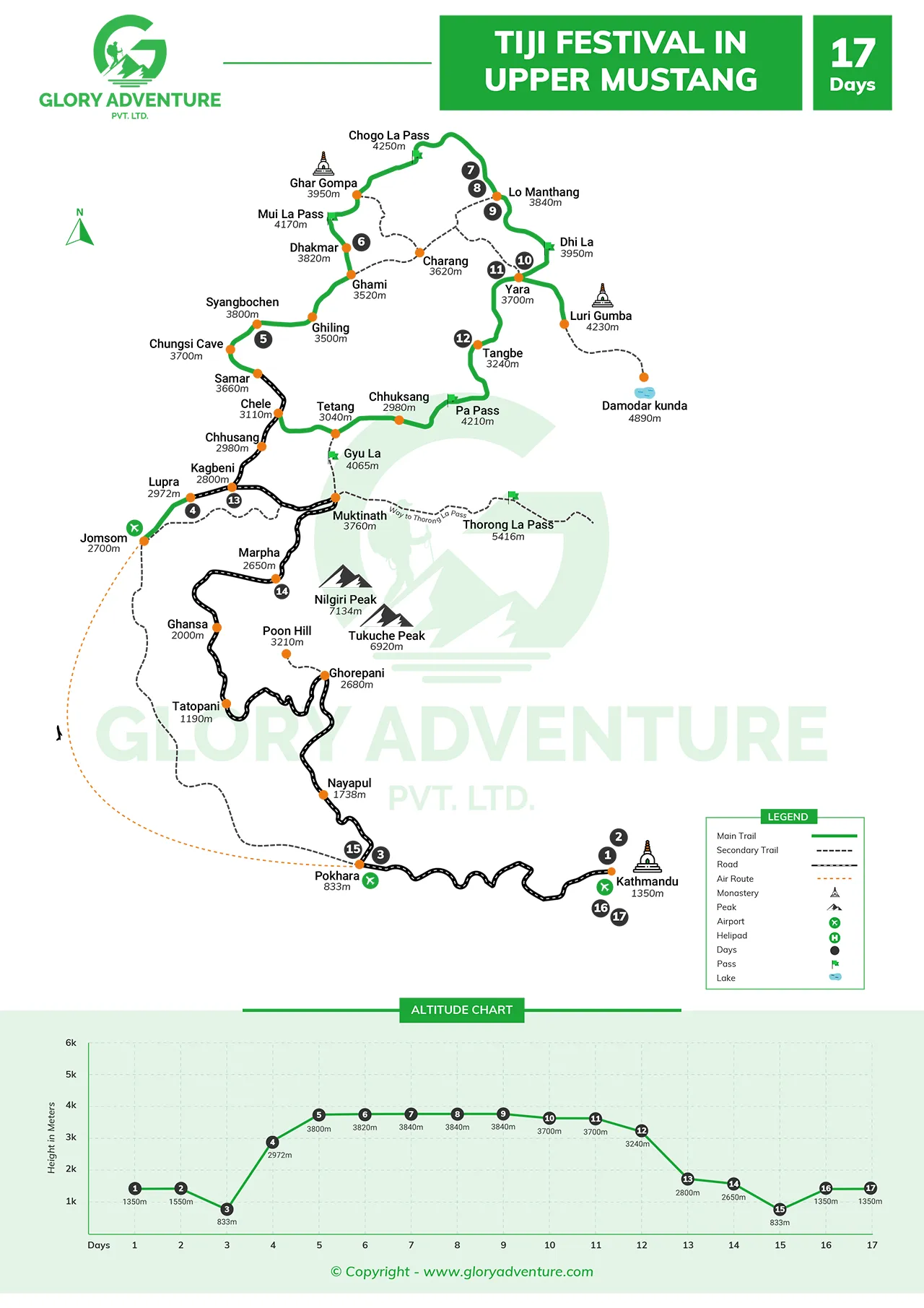
Route Map & Altitude Chart
Essential Information of Tiji Festival in Upper Mustang
Add-Ons
Upgrade Your Accommodation
Upgrading your accommodation is a great way to unwind after a tiring trek to the remote highlands of Upper Mustang. While the Tiji Festival in Upper Mustang trek features tea houses during the trekking days, you can enjoy a range of high-end and luxury hotels in Kathmandu and Pokhara.
How does our trip start?
Our trek starts with a day tour around the Kathmandu valley. After a full day of visiting many attractions in Kathmandu, we will head back to our hotel and spend the night there. The next morning, we will get on a ride to Pokhara, followed by a flight to Jomsom the next day. Thus, we reach the starting point of the trek.
Difficulty
This trek is a moderately difficult experience. While it is not an easy journey, it is also not that difficult. On a scale of 10, our trek experts and guides have given it a 6 because of the few tiring ascents we have to do. Our elevation in the upper region is one of the factors that adds to the difficulty of the trek.
Best seasons
This trek can be done year-round, since the upper Mustang region is minimally affected by the monsoon season. However, there are some options that are better. For instance, the autumn season offers a bunch of great trekking conditions such as peak visibility, clear skies, stable weather patterns, and more. Spring is also one of the best seasons for this trek since it holds similar traits to those of the autumn season.
While you can do this trek in monsoon, winter is not a good option since heavy snowfall can be an issue, and gloomy days can ruin the view of the landscape.
Altitude Sickness
The highest point of this trek is Paha village, reaching 4218 meters above sea level. Most of our days will be spent under 3500 meters of elevation, which is the starting point of altitude sickness. We will be mostly safe from altitude sickness during this trek, as we will follow the preventive measures and also acclimate well.
Accommodation, Food and Drink
Accommodation options are limited to tea houses, lodges, and homestays during the trekking days. The food options there are a mix of local dishes, regional food, Western options, and traditional Nepalese meals. Both your accommodation expenses and 3 meals per day will be provided by the Tiji Festival in Upper Mustang trek package.
Transportation
Every bit of land transportation required by the itinerary will be covered by the trek package, along with a flight to Jomson on the 3rd day of the trek. We will also pick you up and drop you off at the airport.
Permit
A Restricted Area Permit and an Annapurna Conservation Area Permit are all you need to do this trek. The trek package will cover the expenses related to the permits.
Trip preparation and fitness
To prepare for this trek, you have to plan a 4 to 6-week-long physical preparation. The only things you have to focus on are endurance training and leg training. Cardio is a great way to train both at the same time.
Cost & Budget
The cost of the Tiji Festival in Upper Mustang trek is USD 2250 per person. This package will cover things like daily meals, daily accommodations, transportation, permit, local taxes, daily wages of the porters and guides, and more.
Gadgets charging & Internet
The remote village route faces occasional power outages, and most of the residents rely heavily on solar energy. So, you will not have issues charging your devices. However, the same cannot be said for the internet. You will be off the internet for a couple of days at least, since Wi-Fi or mobile data coverage is not available.
Your Extra expenses
Your extra expenses include the things that are not mentioned as inclusive, including but not limited to, extra meals, flight to and from Nepal, additional night stays, tips for the crew members, visa fees, and more.
Things to Remember Before Attending the Tiji Festival in Upper Mustang
- The accommodations in Lo Manthang can get fully booked rather quickly in the festive season, so make sure that you book the trek early.
- Solo and independent trekking is not allowed in the restricted region of Upper Mustang.
- Respect the culture and the religious sites; always dress modestly.
- Carry sleeping bags, sun screen, warm down jackets, gaiters, trekking poles, and other essentials for the trek.
- Photography inside monasteries is not usually allowed. You should ask a local authority if it is okay to take picture of the interiors.
Frequently Asked Question (FAQ’s)
On the 10th day of the trek, we will have to trek from Lo-Manthang to Yara, which has an estimated trek duration of 7 to 8 hours. This is the longest day of the entire Tiji Festival in Upper Mustang itinerary. Despite the long distance and walking hours, you will make it to the destination easily, as the porters will carry your heavy bags and the guide will lead the way.
The Upper Mustang Restricted Area Permit (RAP) is valid for a total of 10 days. You can extend this permit by paying $50 per day over the limit. However, we do not have to do so since we will be spending less than 10 days within the Upper Mustang region. The Tiji Festival in Upper Mustang trek package will cover the permit fees.
Yes, trekking poles are necessary for the descent from Dhakmar since they will greatly reduce the stress on your knees, saving you from pain and inconvenience. They are also great for ascents, providing grip and support to the upper body.
Every visitor is welcome to enter the monasteries at any time of the year, which includes festival periods as well. Festivals bring out a vibrant and decorative side of the monasteries. However, you might not get to enter the main temple at certain times if they are performing great rituals and prayers.
Yes, vegetarian options are available throughout the Tiji Festival in Upper Mustang itinerary. In fact, we recommend trekkers to go vegetarian for the entire journey since meat products might not be properly frozen in the remote villages.
While there is no special food during the festive days, you will get to taste a variety of local dishes that might not be available at tea houses frequently. There will be no delay in services as the monks are the ones who prepare for the festival, not the tea house workers. Your meal options are Dal Bhat, Soup, Noodles, and a few local dishes prepared with locally sourced ingredients.
While there are no particular “water stations”, you can refill your water from local water taps and tanks. These water sources are linked to a local spring water source, which is naturally germ-free, but contaminants can get in from different mediums, so make sure to carry water purification tablets.
Most of the accommodations during the trekking days do not have attached bathrooms; communal bathrooms are the standard practice. In addition to that, the toilets are squat-type, not western sitting toilets. You might find some attached bathrooms and western toilets in the lower region villages.
Throughout the Tiji Festival in the Upper Mustang trek, the lodges and tea houses will offer warm blankets. Some of the highland accommodation might have heavy blankets that are typically used in traditional local houses; these blankets will keep you safe from the cold. The bedrooms are not insulated or heated, so bringing a sleeping bag is also recommended.
While hot drinking water is mostly readily available, hot bath water is prepared on demand. Hot drinking water comes at no charge, but you will have to pay a few bucks to enjoy a hot shower in the cold Himalayas.
Reaching Lo Manthang takes us to 3840 meters above sea level; altitude sickness usually starts from 3500 meters of elevation. So, the answer is yes, you can get altitude sickness at Lo Manthang if you have not acclimatized well. Acclimatization is a key part of any trekking journey, so make sure that you follow all the necessary acclimatization measures as directed by the guide.
During the festive days, we will be going on short acclimatization hikes, exploring monasteries and nearby viewpoints at the hilltop. Climbing high and sleeping low will keep us safe from altitude sickness. If you experience symptoms of altitude sickness during the festive days, you should let the guide know. He will give you a pill to combat the illness or take you down a couple of hundred meters.
Yes, there are health posts in Lo Manthang and some of the villages along the Tiji Festival in Upper Mustang itinerary. However, these health posts are limited in equipment and man power, they are only good for minor treatments of wounds. Meanwhile, emergency services in the remote villages are not available locally, so we will have to contact a rescue helicopter in times of medical emergencies.
Of course, our Tiji Festival in Upper Mustang itinerary is a flexible itinerary, as long as the changes are viable and doable. If you want to skip Mukitnath, we will take you directly to Marpha village to spend the night.
Most of your time during the festive days will be spent within Lo Manthang, with some hours spent exploring monasteries and hiking to nearby viewpoints.
Trip Reviews on Tiji Festival in Upper Mustang

Price starts from
US$ 2137
For group of minimum 3 Pax
US$ 2250
Need Help?
Managing Director Saroj (+977-9806627713)
Related Trips


Saroj Sunar Travel Consultant
Looking for a Private Trip?
Say Hello to Your Travel Consultant
Planning your next getaway? Our travel specialists are ready to design a fully customized package tailored to your interests. If you need help or have any questions, feel free to connect with us—we’re here to guide you from start to finish.
Price starts
US$ 710
✖
Free Trip Planner Talk to Mr. Saroj Sunar

